DIGITAL PUBLIC INFRASTRUCTURE
Digital public infrastructure for traceability, trade and climate
TRST01 designs, builds and operates sovereign-grade systems that a government owns: farmer and plot identity, chain-of-custody records, compliance outputs, carbon registries and digital MRV. Open, interoperable, and with data that stays with the state.
Running at national scale in India, DR Congo and Malawi: BSNR for 1.2 million rubber farmers, the OATS Blueprint with the World Bank, and Lumière, launched at COP31.
THE NEED
Why traceability and climate data need to become public infrastructure
Traceability solutions have existed for more than two decades, and over a hundred applications compete in the market. What is missing is not another app. It is shared infrastructure underneath them: the rails that let farm records, exporter systems, customs and buyers read and write the same evidence.
Regulation is arriving faster than infrastructure, everywhere. Europe has EUDR, CBAM and Digital Product Passports; the US has FSMA 204 for food and UFLPA for forced labour; the UAE has a federal climate law and responsible-gold rules; Southeast Asia is registering smallholder plots and phasing in climate reporting; and India has BRSR and a carbon market. Food, forest commodities, minerals and carbon must now all travel with verifiable evidence.
Systems do not talk to each other. A single mango consignment from Maharashtra can pass through as many as seven digital systems before it reaches a shop in Europe, none of which share data.
Smallholders are priced out. Proprietary, per-buyer systems are expensive, and when every exporter hires its own agency the same farms get mapped again and again.
The gaps already cost exports. India exported USD 48.9 billion of agricultural goods in 2023-24, yet 2 to 8% of shipments are rejected or detained at EU ports and 3 to 6% at US ports, mostly for traceability gaps, residue evidence or certificate-of-origin failures. Unsafe food costs low- and middle-income countries an estimated USD 110 billion a year.
Climate pledges need proof. Article 6 of the Paris Agreement needs continuous, auditable MRV and a national registry, yet most governments still track emissions and credits in scattered spreadsheets.
The regulatory wave, worldwide: food, forests, minerals, carbon and ESG
From Brussels and Washington to Abu Dhabi, Jakarta, Singapore and New Delhi, every rule asks for the same thing: evidence that travels with the product or the company, from source to market. Building that evidence once, as shared infrastructure, is cheaper than rebuilding it for every rule and every market.
Since 2021
Europe · Minerals
EU Conflict Minerals Regulation
EU importers of tin, tantalum, tungsten and gold must run OECD-based supply chain due diligence, including the mine of origin for high-risk areas.
Since 2022
UAE · Minerals
UAE responsible gold sourcing rules
Ministry of Economy due diligence regulations require gold refiners and traders to know and check where their gold comes from.
In force
USA · Forced labour
Uyghur Forced Labor Prevention Act (UFLPA)
Goods made wholly or partly in Xinjiang, or by listed entities, are presumed barred from US import unless the supply chain is traced and proven clean.
In force
Southeast Asia · Food and forests
Palm oil standards and smallholder registration
Indonesia's ISPO and Malaysia's MSPO standards, and Indonesia's STDB certificates that record smallholder identity and plot coordinates, are becoming the base for EUDR evidence.
In force
UAE · Food
UAE food safety controls
Imported, locally made and traded food is registered nationally and monitored from source to consumer by the Ministry of Climate Change and Environment with partner authorities.
In force
India · ESG
India BRSR
SEBI's Business Responsibility and Sustainability Report for India's top 1,000 listed companies, with BRSR Core assurance being phased in.
Since FY 2025
Singapore · ESG
Singapore climate reporting
All listed companies report Scope 1 and 2 emissions from FY2025. The largest (STI) companies also make ISSB-based disclosures and add Scope 3 from FY2026.
Since FY 2025-26
India · Carbon
India Carbon Credit Trading Scheme
Greenhouse-gas intensity targets for about 490 plants in aluminium, cement, chlor-alkali, pulp and paper, refining, petrochemicals and textiles.
Since Jan 2026
Europe · Carbon
EU CBAM
Importers of more than 50 tonnes a year of steel, aluminium, cement, fertilisers, electricity or hydrogen declare embedded emissions. Certificates go on sale in February 2027; the first surrender is due 30 September 2027.
2026
UAE · Carbon
UAE Climate Law (Federal Decree-Law 11 of 2024)
Entities that emit greenhouse gases, including in free zones, must measure and report their emissions. Abu Dhabi already requires annual reports from large facilities.
Since Jul 2026
Europe · Products
EU Digital Product Passport (DPP) under ESPR
The EU's DPP Registry went live in July 2026. Product data stays with the business, but every passport is registered under a unique ID that customs can check at the border. Batteries come first, followed product by product by steel and aluminium, textiles, tyres, furniture, electronics, construction products, toys and detergents.
30 Dec 2026
Europe · Food and forests
EU Deforestation Regulation (EUDR)
Plot geolocation and deforestation-free, legal-production evidence for cattle, cocoa, coffee, palm oil, rubber, soy and wood. Micro and small operators follow on 30 June 2027.
18 Feb 2027
Europe · Products
EU Battery Passport
The first DPP obligation: electric-vehicle, light-transport and large industrial batteries must carry a QR code linking to a digital battery passport with origin, materials and carbon footprint data.
2027
UK · Food and forests
UK forest risk commodities rules
Due diligence on cattle, cocoa, coffee, palm oil, rubber and soy for businesses with more than £1 million turnover, with rules expected in 2027.
FY 2027
Europe · ESG
EU CSRD (after Omnibus I)
Sustainability reporting for companies with more than 1,000 employees and €450 million turnover, including non-EU groups with more than €450 million EU turnover.
18 Aug 2027
Europe · Minerals
EU battery supply chain due diligence
Battery makers must run due diligence on their cobalt, lithium, nickel and natural graphite supply chains.
14 Dec 2027
Europe · Forced labour
EU Forced Labour Regulation
Products made with forced labour are banned from the EU market, and companies under investigation must show where their goods come from.
20 Jul 2028
USA · Food
US FSMA Section 204
Lot-level traceability records for foods on the FDA Food Traceability List, to be handed over within 24 hours of a request.
26 Jul 2029
Europe · ESG
EU CSDDD (after Omnibus I)
Human-rights and environmental due diligence across the value chain for the largest companies, with 5,000+ employees and €1.5 billion turnover.
Rolling
Global · ESG
ISSB standards (IFRS S1 and S2)
Global sustainability and climate disclosure standards being adopted or used by more than 30 jurisdictions.
Dates as at November 2026. Several rules have been amended recently, so check the official texts before acting.
Where this is heading: from sharing data to proving it
Regulators are no longer asking companies to email spreadsheets. They are building public systems that hold the record and check it. The direction is clear: connected registries, consent in the hands of the people the data is about, and proof that can be verified without handing over the raw data.
Public registries
Rules now run on public systems
EUDR statements are filed in the EU Information System, CBAM runs through the CBAM Registry, ESPR sets up an EU registry for Digital Product Passports, India's carbon market has a national registry, and Article 6 needs national carbon registries. Compliance is becoming a conversation between public systems.
Connected registries
Linked, not centralised
Farmer, plot, facility, product and company registries are joined through shared identifiers and open APIs, so a lot can be traced across them. Each record stays with the agency that owns it; what moves between systems is a reference, not a copy.
Consent and privacy
Consent first, privacy by design
Laws such as India's Digital Personal Data Protection Act and the EU's GDPR put the farmer, cooperative or exporter in control of their data. Consent-based designs like India's DEPA let each party approve, limit and revoke who sees what, with every access logged.
Validation
Verify, don't share
Verifiable credentials and cryptographic proofs let a party prove a claim, such as "this plot is deforestation-free" or "this lot is certified organic", without exposing the underlying data. Buyers and regulators check the proof against the issuing registry instead of collecting more data.
Why every country and region needs its own DPI
Law
Laws differ
Data protection, data residency and land-tenure rules are national, so the system that holds farmer and plot data has to sit under the country's own law.
Records
Records are local
Land titles, farmer IDs, cooperative and exporter registries already exist in each country, and DPI has to connect to them rather than replace them.
Ground reality
Ground reality is local
Crops, languages, connectivity and field practices vary by region, and so do the apps and support farmers need.
Sovereignty
Trade and carbon data are strategic
Who holds a country's supply-chain evidence and carbon assets is a question of sovereignty, not just IT.
The answer is one shared set of open standards with many sovereign deployments: national, state or regional systems that each country owns, which still speak the same language as their trading partners and regulators abroad.
India has already shown the answer with Aadhaar for identity and UPI for payments: an open, shared base layer owned by the public, with companies competing on what they build on top. Traceability and carbon fit the same pattern.
CASE STUDIES
DPI already running with governments
India · Natural rubber
BSNR with the Rubber Board of India
India's national EUDR traceability platform for 1.2 million smallholder rubber farmers, at zero cost to the value chain. By July 2026 it had onboarded 28,255 growers, 56,159+ hectares, 573 dealers, processors and manufacturers, and 140 exporters.
Read the case study →
India · Agri-traceability DPI
OATS with the World Bank and Maharashtra
An open, vendor-neutral agri-traceability stack commissioned by the World Bank and the Government of Maharashtra, authored by a TRST01-led consortium and published as a global public good under CC BY 4.0.
Read the case study →
DR Congo · Carbon registry
Lumière, a sovereign carbon registry
A four-tier national registry for the Ministry of Environment (MEDDNEC) to issue, authorise and track Article 6 carbon credits, launched at COP31 in Antalya in November 2026.
Read the case study →
Malawi · Climate treasury
The Paris Agreement Implementation Platform
Built with the Green Economy Partnership for Malawi's Ministry of Natural Resources and Climate Change, and launched at COP30 in Belém. Malawi owns and operates its Environmental Treasury.
Read the case study →
India · Uttar Pradesh
Kisan Samrudhi farmer carbon programme
A state-facilitated digital MRV programme with IIT Roorkee across a 500,000-hectare Verra-registered area in Saharanpur and Muzaffarnagar. Farmers pay nothing and receive 50% of carbon revenue.
Read the case study →
India · Telangana
Tandur red gram GI traceability
A mandate from Telangana Technology Services for the State Agriculture Department to bring about 65,000 farmers onto one platform, so only red gram grown inside the GI boundary carries a verified Tandur origin.
Read the case study →
WHAT WE BUILD
Four systems, one sovereign foundation
Traceability
National traceability systems
Farmer and plot identity, geo-polygon mapping, chain of custody from farm gate to port, and compliance outputs such as EUDR Due Diligence Statements, under government oversight.
Carbon markets
Sovereign carbon registries
Government-owned registries and marketplaces, Article 6.2 and ITMO-ready, where a nation issues, authorises and tracks credits under its own authority.
Climate programmes
Digital MRV
Satellite, AI and field data that verify practice change and emission reductions plot by plot, with tamper-evident records ready for Verra or Gold Standard verification.
Sustainability
ESG and disclosure systems
Institution-grade platforms for sustainability data, disclosure and monitoring across ministries, portfolios and multi-stakeholder programmes.
THE ARCHITECTURE
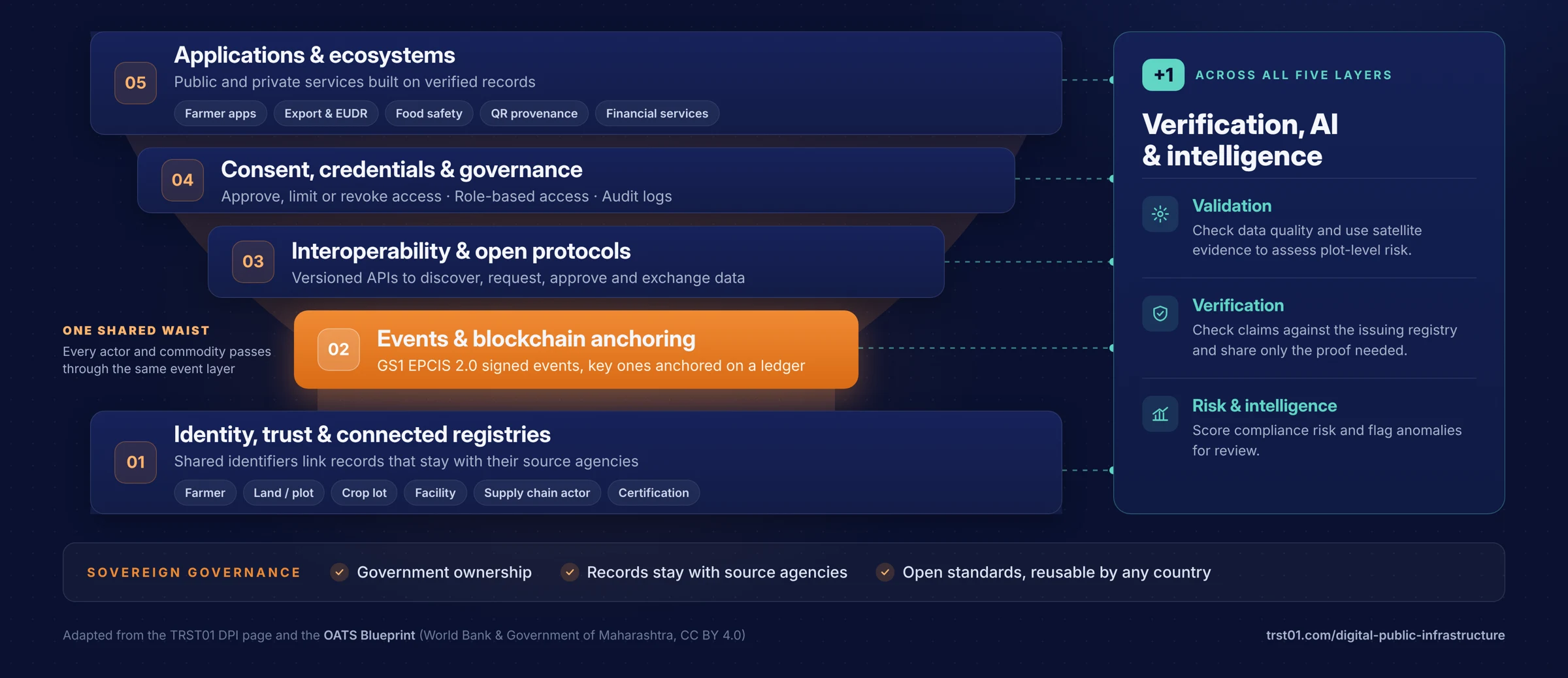
How a traceability DPI is built: five layers plus one
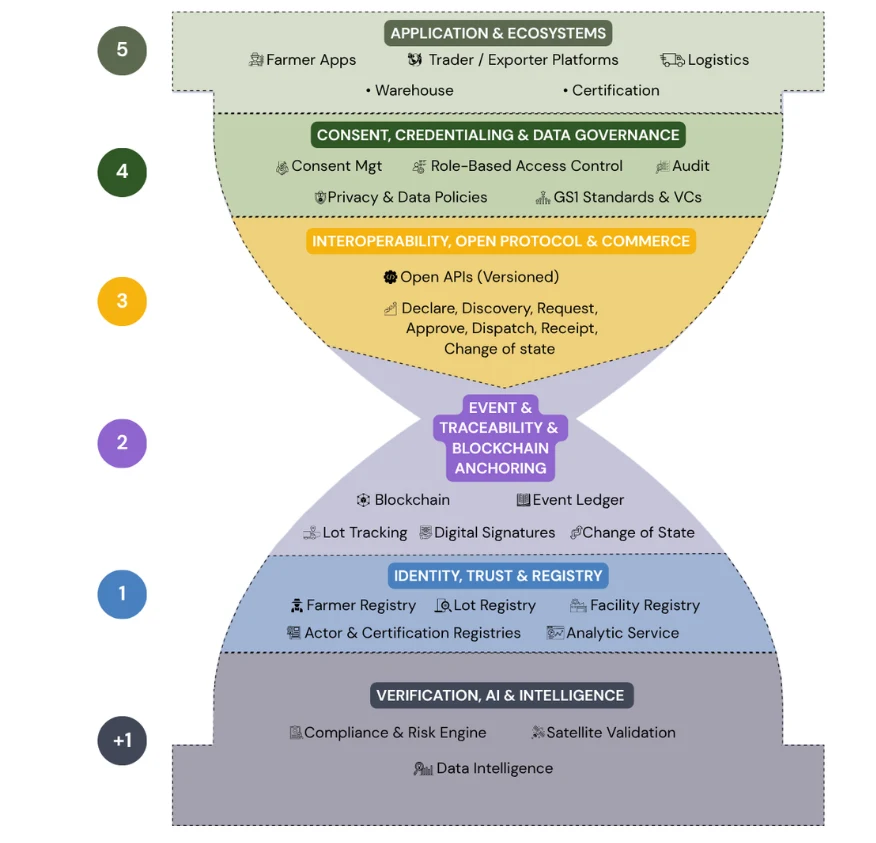
Open AgriTrace Stack (OATS). Commissioned by the World Bank and the Government of Maharashtra, authored by a TRST01-led consortium, and published as a global public good under CC BY 4.0.
Our DPI follows the open five-plus-one layer architecture of the Open AgriTrace Stack (OATS). It is shaped like an hourglass: many registries at the base and many applications at the top, joined by one narrow, shared event layer built on GS1 EPCIS 2.0 (ISO/IEC 19987:2024). Because every actor and every commodity passes through that same waist, a cotton bale, a turmeric lot and a shrimp consignment run on the same rails. Each layer can be adopted on its own, so a state can start with what it needs and add the rest later.
Layer 1 · Identity, trust and registry. Farmer, lot, facility, actor and certification registries: who and what exists in the supply chain.
Layer 2 · Events and blockchain anchoring. Every lot movement and change of state, digitally signed and anchored to a ledger.
Layer 3 · Interoperability and open protocols. Versioned open APIs to declare, discover, request, approve, dispatch and receive.
Layer 4 · Consent, credentials and data governance. Consent, role-based access, audit, GS1 standards and verifiable credentials.
Layer 5 · Applications and ecosystems. Farmer apps, trader and exporter platforms, logistics, warehouses and certification.
+1 · Verification, AI and intelligence. A compliance and risk engine, satellite validation and data intelligence across every layer.
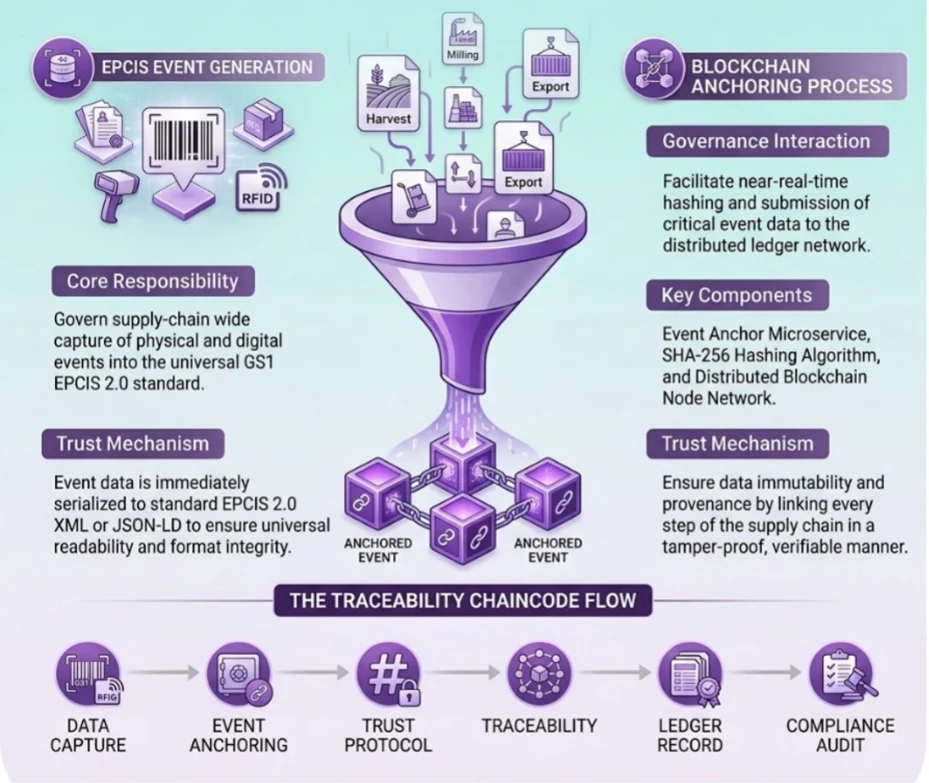
Layer 2
Events and blockchain anchoring
Every harvest, aggregation, processing and export step is captured as a signed GS1 EPCIS 2.0 event, using ten Critical Tracking Events and a 45-element data matrix. A Birth-of-Lot rule stops lots being silently merged or split. Blockchain is not the default store: routine events stay in scalable EPCIS repositories, and only high-value, compliance-critical events, such as certificate issuance and cross-border attestations, are hash-anchored on Hyperledger Fabric.
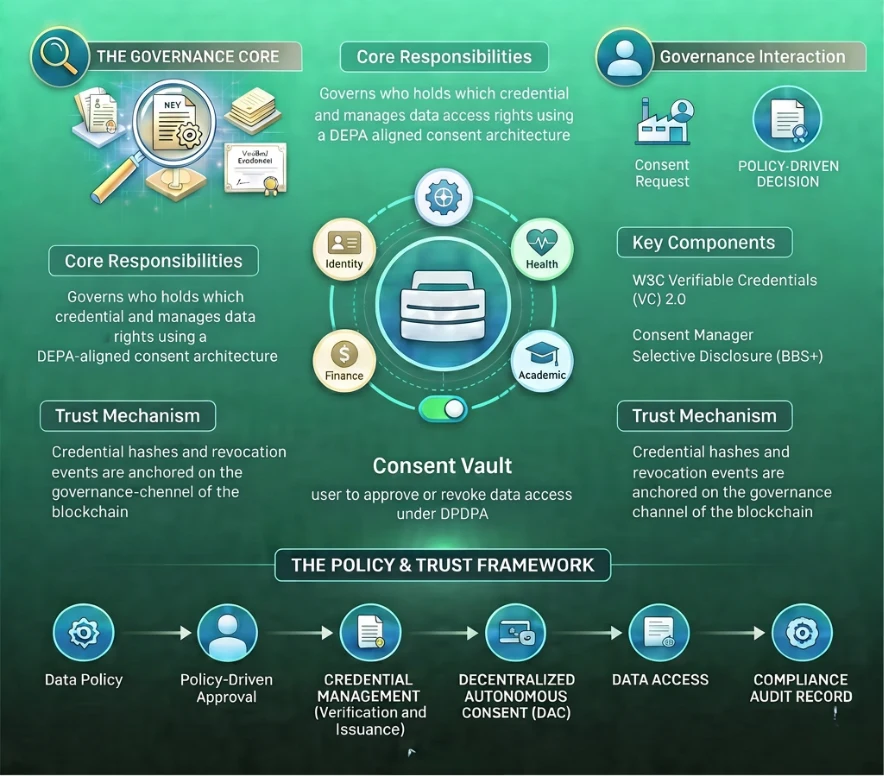
Layer 4
Consent, credentials and data governance
Decides who holds which credential and who may see which data. Built on W3C Verifiable Credentials 2.0, a consent manager with selective disclosure and a DEPA-aligned consent design, so farmers and firms can approve or revoke access under India's DPDP Act. Credential and revocation hashes are anchored on the ledger's governance channel.
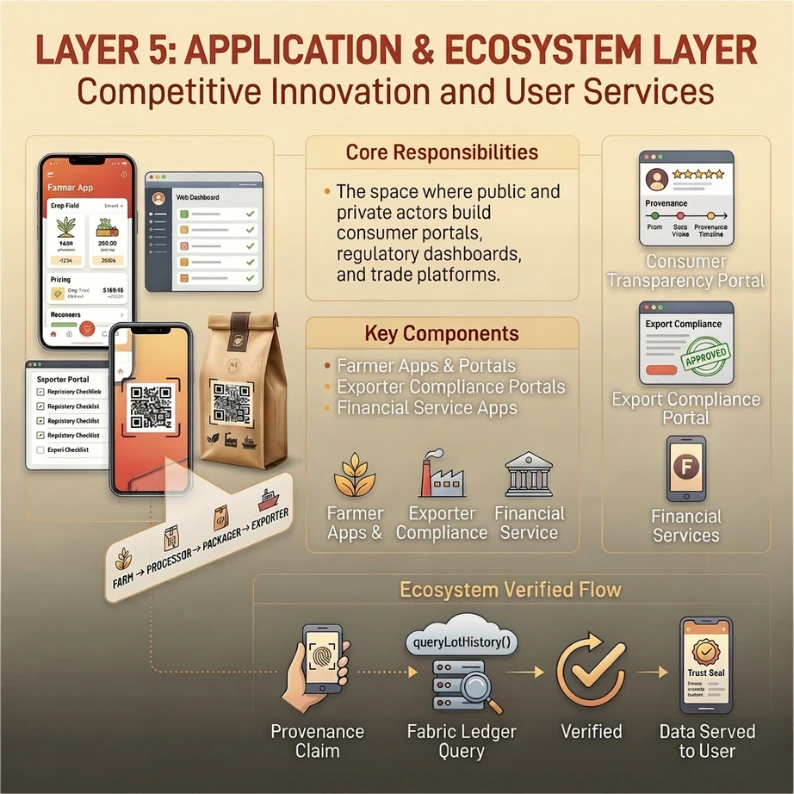
Layer 5
Applications and ecosystem
The open space where public and private players compete to build on the shared rails: farmer apps, exporter compliance portals, regulators' dashboards, consumer QR provenance and financial services. Any app can query a lot's verified history and show it to its users.
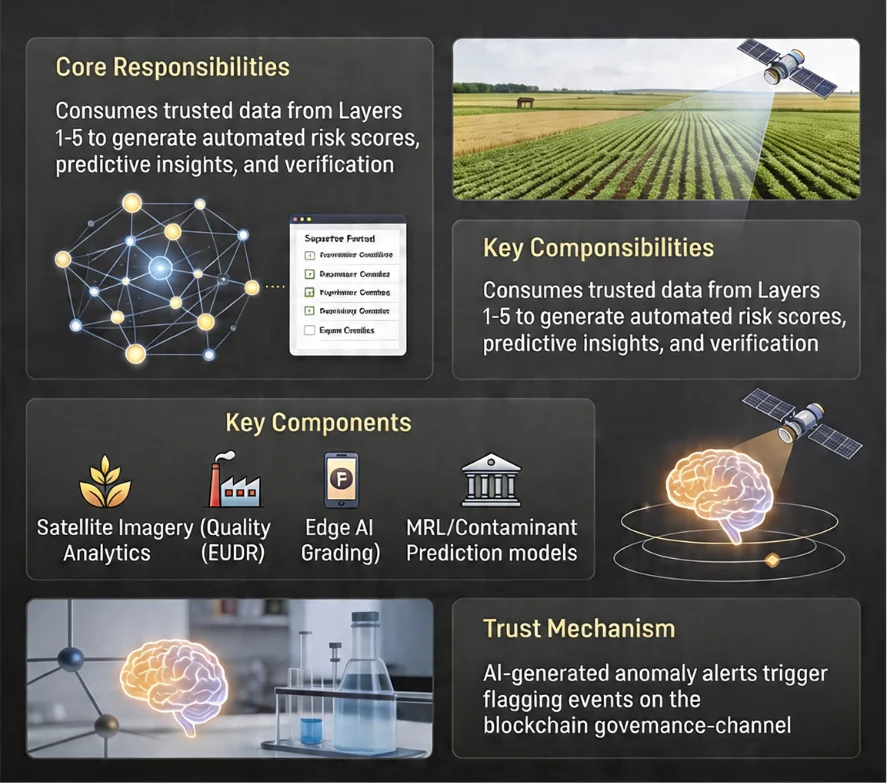
+1 layer
Verification, AI and intelligence
Reads trusted data from the other layers to score risk and verify claims automatically: satellite imagery analysis for EUDR deforestation checks, edge-AI quality grading and residue (MRL) prediction. Anomalies are flagged on the ledger's governance channel for review.
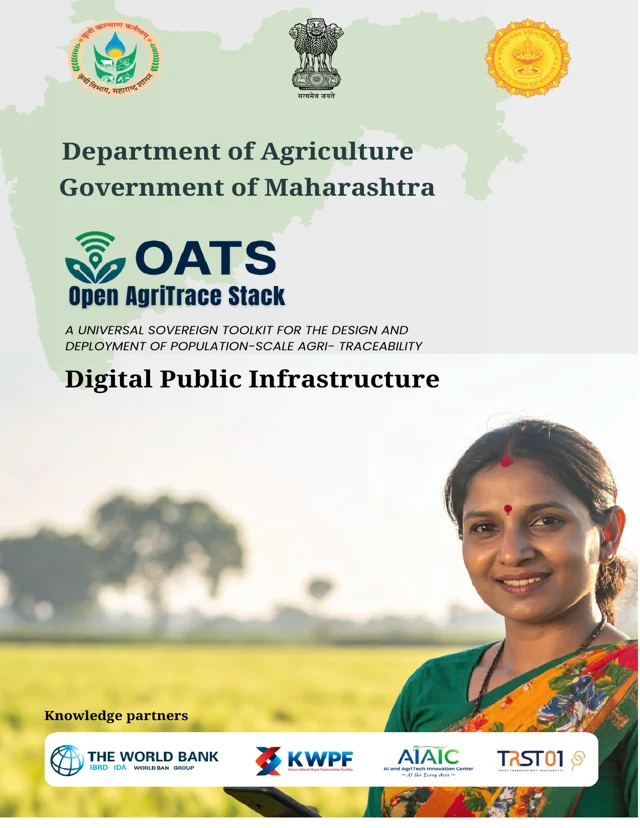
PDF · 135 pages · 6 MB
FREE DOWNLOAD
The OATS Blueprint: an open reference architecture for agri-traceability DPI
A blueprint and toolkit for designing and deploying population-scale agri-traceability, commissioned by the World Bank with the Department of Agriculture, Government of Maharashtra, and financed by the Korea-World Bank Partnership Facility. It was written by the TRST01-led consortium with ICAR-CIRCOT, GS1 India and Tetra Information Services, and peer reviewed by the Centre for Digital Public Infrastructure and the World Economic Forum's C4IR.
16 chapters, from vision to value-chain finance
5+1 layer reference architecture
3 deployment paths and conformance levels
CC BY 4.0: free to use, adapt and translate
DESIGN PRINCIPLES
Built with you, owned by you
Sovereign ownership. Data, authority and governance stay with the state, with ministry-level permissions and audit-ready controls. We build and operate; the government owns.
Open and interoperable. Built on open standards, including GS1 identifiers and EPCIS 2.0, W3C Verifiable Credentials, the Beckn open protocol and OpenAPI 3.1, and following G20 DPI principles, so no government is locked into one vendor.
Zero cost to the farmer. In BSNR and the OATS design, farmers pay nothing to enrol a plot, record a harvest or prove origin.
Built for ground reality. Multilingual apps, offline plot mapping and field teams for first-time digital users, as in BSNR's Malayalam, Kannada, Tamil and Hindi interfaces.
Pilot to national scale. The architecture that runs one district or corridor scales to a national system without a rebuild.
Three ways to start
Greenfield national system. The full stack, deployed by a national or state government with no traceability infrastructure in place.
Build on what exists. Selected modules connect to existing systems such as AgriStack, APEDA, FSSAI and ERP platforms, without replacing them.
One commodity first. A single value chain, such as rubber, coffee, cotton or shrimp, built against one market rule like EUDR, then extended to others on the same rails.
RECENT WORK
Milestones
November 2026. Lumière, DR Congo's sovereign carbon registry, launched at COP31 in Antalya.
October 2026. Telangana Technology Services awarded TRST01 the Tandur red gram traceability mandate for about 65,000 farmers.
June 2026. Lumière presented at the 8th Global Environment Facility Assembly in Samarkand, after the DRC named it its national registry at Ecosperity Week in Singapore in May.
2026. OATS Blueprint published for the World Bank and the Department of Agriculture, Government of Maharashtra, after peer review by the Centre for Digital Public Infrastructure (CDPI) and the World Economic Forum's C4IR; Kisan Samrudhi Phase 1 mobilisation under way in Uttar Pradesh.
November 2025. Malawi's Paris Agreement Implementation Platform and Environmental Treasury launched at COP30 in Belém.
February 2025. The Rubber Board of India launched iSNR, now BSNR, with TRST01 as technology and implementation partner.
Frequently asked questions
What is digital public infrastructure (DPI)?
Shared, interoperable digital systems built on open standards that a whole country can use, such as India's Aadhaar for identity and UPI for payments. Traceability DPI applies the same idea to farmer identity, plot records and the movement of goods, and climate DPI to carbon registries and MRV.
How is DPI different from buying traceability software?
Software is usually owned by a vendor and sold company by company. DPI is a shared base layer owned by the public, so every exporter, cooperative and buyer uses the same records, farms are mapped once instead of many times, and companies compete on what they build on top.
Who owns the data and the system?
The government. Data, authority and governance stay with the state, with ministry-level permissions and audit-ready controls. TRST01 designs, builds and operates the system on the government's behalf.
Do farmers pay to use it?
No. In BSNR, no farmer, dealer, processor or manufacturer pays for compliance, and the OATS design sets zero cost to the farmer at the point of use.
Which standards does TRST01's DPI follow?
GS1 identifiers and EPCIS 2.0 for supply chain events, W3C Verifiable Credentials, open APIs and G20 DPI principles; and for carbon, Paris Agreement Article 6.2 and ITMO workflows, UNFCCC and NDC reporting, and Verra and Gold Standard methodologies.
Can we use the OATS Blueprint for our own country or state?
Yes. The OATS Blueprint is published under a Creative Commons Attribution 4.0 licence, so any government, multilateral agency, standards body or implementing partner can use, adapt and translate it without permission or licence fees. You can download the full Blueprint free from this page.
TALK TO AN EXPERT
Speak directly with the people building national DPI
Planning a traceability, registry or carbon programme? Write to our leadership team and we'll set up a conversation.