Tandur Dal: An Old Love Story, a New Chapter
By Prabir Mishra, Founder & CEO, TRST01 · 23 October 2026 · Weekly Traceability Series
Tur dal is on almost every Indian plate. One kind of it, grown on the black soils around Tandur in Telangana, has a name that buyers already trust. In December 2022 Tandur Red Gram became Telangana’s first farm product with a Geographical Indication (GI) tag. That tag was a promise: that the name would belong to the farmers of Tandur, and that it would earn them more.
This week that promise gets a new chapter. On 19 October, Telangana Technology Services (TGTS) awarded TRST01 the mandate to build digital traceability for Tandur Red Gram for the State’s Agriculture Department, bringing about 65,000 farmers onto one platform.[1] As the team doing the work, we are proud of it. But the story is bigger than one project. It is about what it takes for any GI product to keep its promise.
The past promise
Tandur Red Gram is a rainfed pigeon pea grown mainly in four mandals of Vikarabad district: Tandur, Peddemul, Basheerabad and Yalal. The area is about 1 lakh acres, with average production of about 4 lakh quintals a year.[2] Its taste, cooking quality and 22 to 24% protein content are credited to deep black soils rich in limestone.[3] A PJTSAU scientist called it “a lifeline for the dryland farming community in the Tandur region.”[4]
The GI journey took time. Yalal Farmers Producer Company filed the application in September 2020, with support from Professor Jayashankar Telangana State Agricultural University (PJTSAU), and the certificate was issued on 6 December 2022.[5] A GI tag means the name can be used only by registered producers from the defined area. Third parties cannot use it.[4]
Some promises were older still. A Red Gram Board for the region was promised during the 2014 election campaign, and nearly ten years later it had still not been set up.[2] A year after the GI tag, a PTI report found that many farmers were not aware of what it meant. Scientists and traders expected a GI premium of about ₹300 to ₹500 a quintal, yet only a few hundred growers had registered against a target of 1,000 per mandal.[2] One farmer from Basheerabad with 25 acres, asked about the tag, said simply: “I am not aware of it.”[2]
Why a GI tag alone is not enough
A GI tag protects a name in law. It does not, by itself, protect the name on a shop shelf. Today Tandur dal sells at about ₹150 to ₹200 a kg in retail, and sometimes up to ₹300 a kg online.[6] A premium like that is exactly what invites copies. A bag of ordinary tur with “Tandur” printed on it looks the same as the real thing.
India has seen this before. Darjeeling tea, India’s first GI, produces only around 8.5 million kg a year, yet by some estimates around 50 million kg is sold around the world under the Darjeeling name.[7] When the market cannot tell real from copied, the copy wins on price and the genuine grower loses twice: once on the premium, and again on reputation.
There is a second problem. Tur moves from small farms through village collectors, traders and mills. By the time it reaches a packet, the farmer’s name is long gone. Without a record, there is no way to prove that a lot came from inside the GI area, and no way to pass the premium back to the person who grew it.
The new story
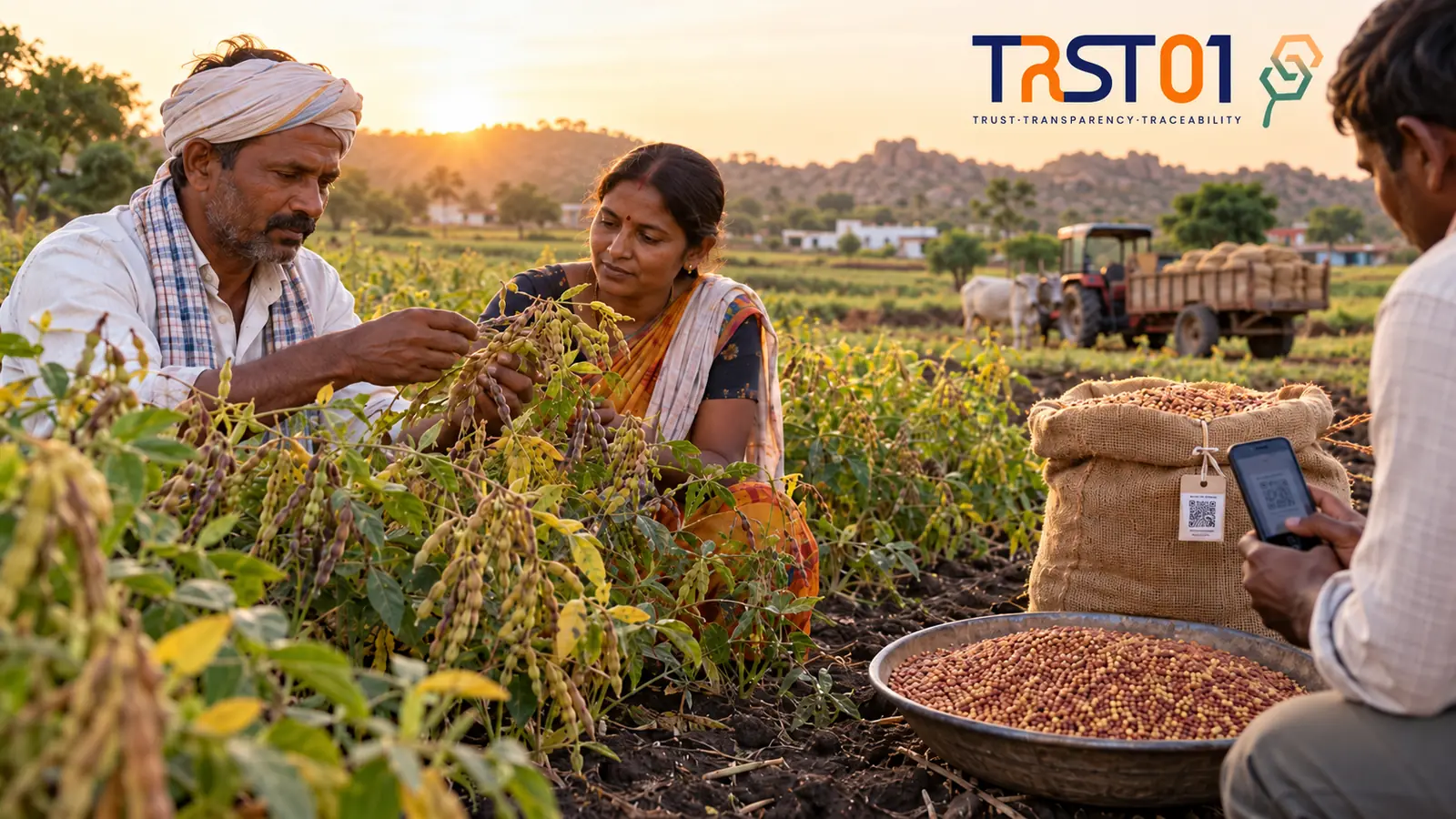
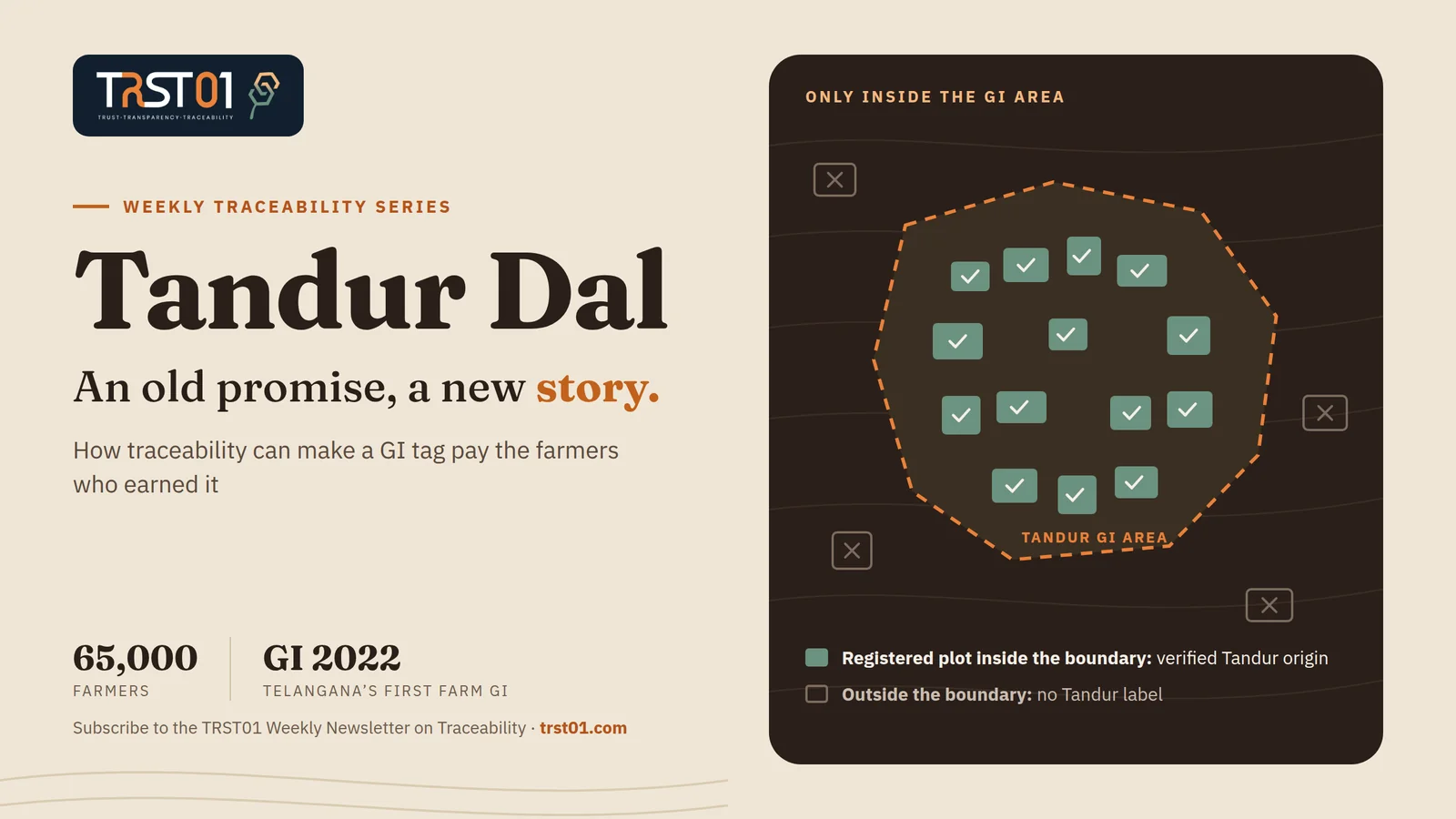
The new project starts where the GI tag stops. Under the National e Governance Plan in Agriculture (NeGPA) 2025/26,[1] each farmer will get a digital profile linked to their land, crop and harvest, with a unique digital identity. Farm plots will be mapped and checked against the registered GI area. A digital record will follow the produce from the plot through aggregation, processing and distribution to the buyer.[3]
The rule at the heart of it is simple: only red gram grown inside the GI boundary by a registered farmer can carry a verified Tandur origin.[1] The stated aims are to curb fake “Tandur Dal”, strengthen farmers’ bargaining power, and bring more women farmers into the system.[3]
This builds on earlier work. In 2023 TRST01 worked with Yalal Farmers Producer Company, which has over 800 small and marginal farmers, on a QR code that let a buyer see a packet’s origin, harvest date and journey.[8] When the GI tag came through, The Times of India reported the story under the headline “Blockchain tech helped Tandur tur dal bag GI tag”.[9] The new mandate takes that idea from one producer company to an entire GI region.
“Tandur Dal is Telangana’s pride, and we are privileged to contribute to its digital journey,” TRST01 founder and CEO Prabir Mishra said, adding that a transparent digital identity could improve farmers’ bargaining power, particularly for women growers.[1]
What changes, and for whom
For farmers. A verified profile turns a GI tag into something a farmer can use: proof of origin to claim a premium, records for credit and insurance, and a direct link to buyers. It also helps with government buying. Under the Mission for Aatmanirbharta in Pulses, NAFED and NCCF will procure 100% of tur, urad and masoor offered by registered farmers at the minimum support price for four years.[10] For 2026/27 the tur MSP is ₹8,450 a quintal.[11]
For buyers. A retailer, processor or exporter can check that a lot is genuine before paying a premium for it, and show the same proof to their own customers.
For government. Real data on who grows what, where and how much makes procurement, seed distribution and drought relief easier to plan. The pulses mission already tracks seed through the SATHI portal;[10] farm and lot records extend that chain from the seed to the sale.
Not just a Tandur story
India imported a record 12.33 lakh tonnes of tur in 2024, mostly from Myanmar and East Africa, including Mozambique, Malawi and Tanzania, and tur imports stay duty free until 31 March 2027.[12] Imported and Indian tur often pass through the same traders, warehouses and mills. That makes origin proof even more important for a premium product like Tandur dal.
It matters for exporting countries too. Mozambique grows tur mainly for India, and its trade has been hit by disputes over who controls exports and how prices are set.[13] Farmers in Africa, Myanmar or anywhere else who can show where their crop was grown, and by whom, are in a stronger position to sell on quality rather than on volume alone.
The same lesson applies to every origin product, from GI pulses and rice in South Asia to coffee and spices in Southeast Asia and Africa. A name protects value only when it can be proven at the point of sale.
Five steps to make any GI tag pay
1. Register every grower. A GI is only as strong as its list of authorised producers. Make registration easy and close to the farm.
2. Map plots against the GI boundary. Origin should be a fact on a map, not a word on a label.
3. Give every lot an identity. A lot ID that follows the produce through collection, milling and packing is what links a packet back to a farm.
4. Put proof on the pack. A QR code or label that buyers can check turns a legal right into a market advantage.
5. Send the premium back. Use the records to pay farmers for verified GI produce, so the people who earned the name share in its value.
The bigger picture
A GI tag tells the world that a place makes something special. Traceability lets the world check. For Tandur, the old promise was recognition. The new story is proof, farm by farm and lot by lot. If it works here, it can become a model for GI products across India and beyond.
At TRST01, we build traceability infrastructure that links farms, stocks, processing and shipments into one verifiable record, for farmers, processors, exporters and governments. Learn more at trst01.com.
Subscribe to the TRST01 Weekly Newsletter on Traceability for a plain language update every week on the rules and risks shaping global trade. Share this with someone who grows, trades or buys a GI product.
References
[1] NewsMeter, “Digital trail for Tandur Red Gram: Hyderabad firm TRST01 to bring 65,000 farmers onto one platform” (19 October 2026). newsmeter.in
[2] Business Standard (PTI), “Telangana farmers wait for red gram board a year after receiving GI tag” (17 November 2023). business-standard.com
[3] Telangana Today, “TrayamBhu Tech Solutions to digitally trace GI tagged Tandur Red Gram, cover 65,000 farmers” (19 October 2026). telanganatoday.com
[4] APEDA AgriExchange, “Tandur red gram gets GI tag” (16 December 2022). agriexchange.apeda.gov.in
[5] Telangana360, “Tandur Red Gram” (GI application, journal and certificate details). telangana360.com
[6] 30 Stades, “How Telangana’s GI tagged Tandur dal went from local staple to premium product” (3 April 2026). 30stades.com
[7] Finshots, “How an imposter has been threatening the champagne of teas” (23 August 2023). finshots.in
[8] Prabir Mishra, “TRST01 creates value through blockchain traceability”, Medium (1 February 2023). prabir-mishra.medium.com
[9] The Times of India, Hyderabad, “Blockchain tech helped Tandur tur dal bag GI tag”. timesofindia.indiatimes.com
[10] PM India, “Union Cabinet approves Mission for Aatmanirbharta in Pulses for 2025/26 to 2030/31” (1 October 2025). pmindia.gov.in
[11] DT Next, “Govt hikes paddy MSP by Rs 72 to Rs 2,441/qtl” (13 May 2026). dtnext.in
[12] JV Agro, “Tur imports stay duty free until March 2027: what it means for prices” (8 October 2026). jvagro.com
[13] India Seatrade News, “Govt may revoke tur dal MoU with Mozambique” (24 November 2023). indiaseatradenews.com