How India built one national answer to EUDR for 1.2 million rubber farmers

Challenge
The EU Deforestation Regulation (EUDR) changed the rules of global rubber trade. From 30 December 2026 for large and medium operators, and 30 June 2027 for micro and small enterprises, no consignment of natural rubber or any product containing it, from tyres to industrial goods, can enter the EU market without proof that it is deforestation-free against a 31 December 2020 baseline and legally produced.
For every shipment an exporter must supply geo-polygons of every farm contributing rubber to the consignment, verified against forest datasets; legality evidence covering lawful land ownership and production; a Due Diligence Statement filed in the EU Information System, without which the shipment cannot clear customs; unbroken traceability from farm through dealers, processors, manufacturers and exporters; and a risk assessment across every stakeholder in the chain.
The stakes were unambiguous. Rejected consignments, penalties of up to 4 percent of an operator's annual EU turnover, and exclusion from a market taking roughly a quarter of India's rubber and rubber-product exports, worth over 9,000 crore rupees.
Why India's supply chain made this uniquely hard
- Extreme fragmentation. More than 1.2 million smallholder farmers cultivate rubber on small, scattered plots, which makes polygon mapping a monumental task.
- Multi-layered intermediation. Rubber passes through sub-dealers, dealers and processors before reaching manufacturers and exporters, so no single company can reconstruct the full chain of custody.
- Prohibitive cost for MSMEs. Mapping plots, linking them to consignments and maintaining custody records is technically complex and financially out of reach for small exporters, processors and farmer groups acting alone.
- Massive duplication. If every exporter hired its own agency, the same farms would be mapped repeatedly, multiplying cost across the whole industry.
When I first heard about the new EUDR regulation, I felt a deep fear. I have always farmed legally in a non-deforested area, yet the thought of losing access to markets because of documents and technology I had never seen before was overwhelming. The pressure was heavy. How could a small farmer like me meet requirements meant for big companies? The BSNR initiative has come as a relief, giving us the confidence that even a smallholder farmer like me can meet the global requirements.
Padmanabhan, natural rubber smallholder farmer, Ernakulam district, Kerala
Approach
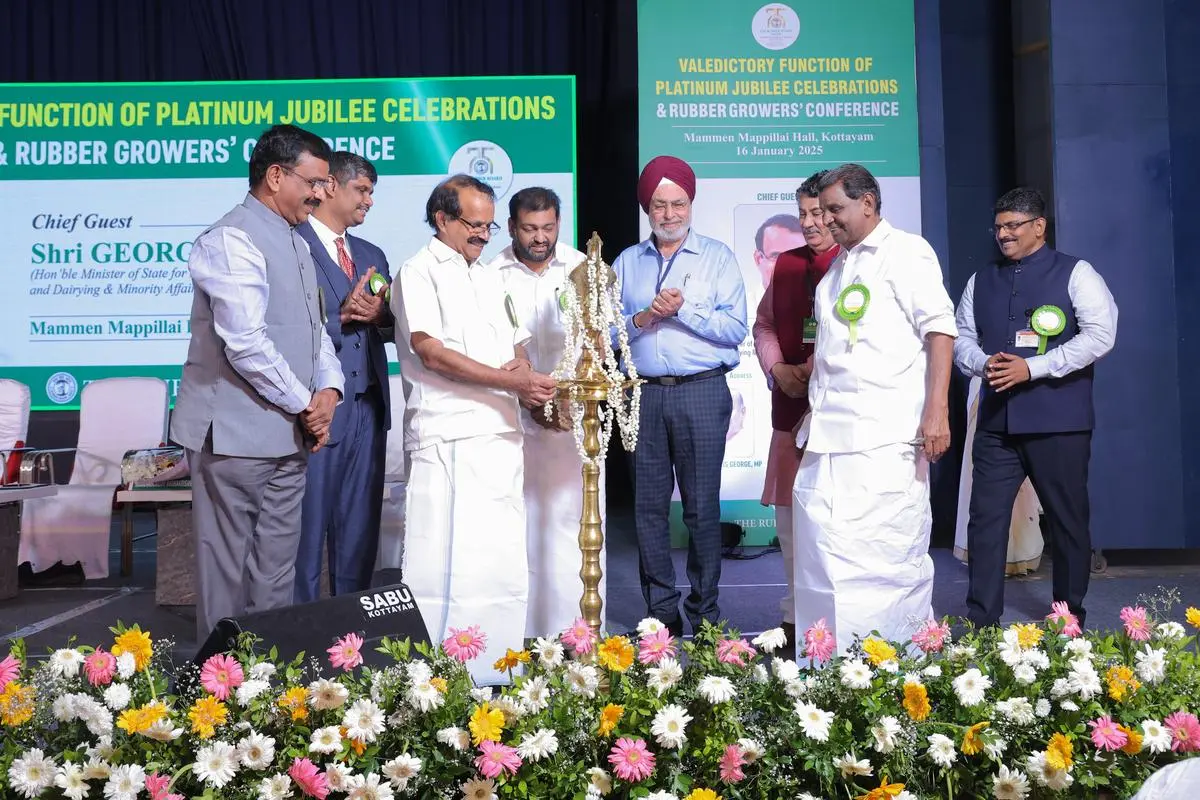
Rather than leaving compliance to thousands of individual companies and small holders left out, …the Rubber Board of India stepped in and launched Bharat Sustainable Natural Rubber (BSNR), first introduced in February 2025 as Indian Sustainable Natural Rubber (iSNR), a nation-wide initiative for EUDR compliance, with TRST01 as its technology and implementation partner. The Ministry of Commerce and Industry subsequently designated the Rubber Board as the nodal agency for EUDR compliance for rubber, making BSNR India's official national answer to the regulation.
The partnership was deliberate in its design
- Zero cost to the value chain. No smallholder farmer, dealer, processor or manufacturer bears the cost of compliance.
- One system, one standard. A single coordinated platform replaces fragmented, company-led compliance, removing duplication and holding data quality uniform.
- Data sovereignty. All data sits in a centralised database under the direct supervision of the Rubber Board. Stakeholder identities are anonymised through unique BSNR IDs, and the platform is built to meet GDPR and global data-protection standards.
- Technology built for ground reality. The platform is designed for first-time digital users, with multilingual interfaces including Malayalam, Kannada, Tamil and Hindi, and online and offline polygon mapping for areas without connectivity.
Technology alone does not map a million farms.
Execution on the ground
- 277 TRST01 field agents deployed across 10 districts in Phase 1, visiting farms in person to capture plot boundaries as GPS-digitised GeoJSON polygons, along with ownership documents and photographic evidence.
- Capacity-building and sensitisation programmes run by TRST01 with the Rubber Board for farmers, estates, dealers, processors, manufacturers and exporters, simplifying registration and transaction recording for first-time technology users.
- A phased rollout across all 8 rubber-growing states, beginning in South, North and Central Kerala.
Solution
Developed by TRST01 under the supervision of the Rubber Board, the BSNR platform provides centralised, digital-first compliance infrastructure for the entire natural rubber ecosystem. Through it, stakeholders can:
- Register under the Rubber Board's national traceability framework with a unique BSNR ID.
- Digitally map the geo-polygon of every cultivation plot, verified against deforestation datasets.
- Complete risk assessments across the twelve categories EUDR Article 10 requires, and follow mitigation protocols where needed.
- Record every transaction, creating an unbroken chain of custody from farm gate to port.
- Store legality and compliance documents in a secure central database, retained for the five-year audit period.
- Generate traceability certificates linked to verified land and practices.
- Submit Due Diligence Statements, GeoJSON files and supporting documents directly to the EU Information System.
By the time rubber reaches an exporter, compliance is already complete. The documentation is generated with minimal effort at the final step.
Without a comprehensive compliance system, India faced the possibility of losing close to ten thousand crore rupees worth of exports, and with it the income of 1.3 million smallholder farmers and countless MSMEs. BSNR was developed with technology tailored to the practical conditions of the Indian rubber sector, designed not only to meet today's requirements but to keep the industry prepared for future global regulations.
How every record is verified: three tiers, six satellite layers
No farmer record enters the procurement flow until it clears three independent validation tiers:
- District Data Validator. A dedicated validator in each district reviews the field-collected data and documentation.
- TRST01 validation team. Verifies the plot for deforestation, performs the legality and country-of-production analysis, and confirms the documentation is complete.
- Rubber Board. Final statutory validation by the Government of India body.
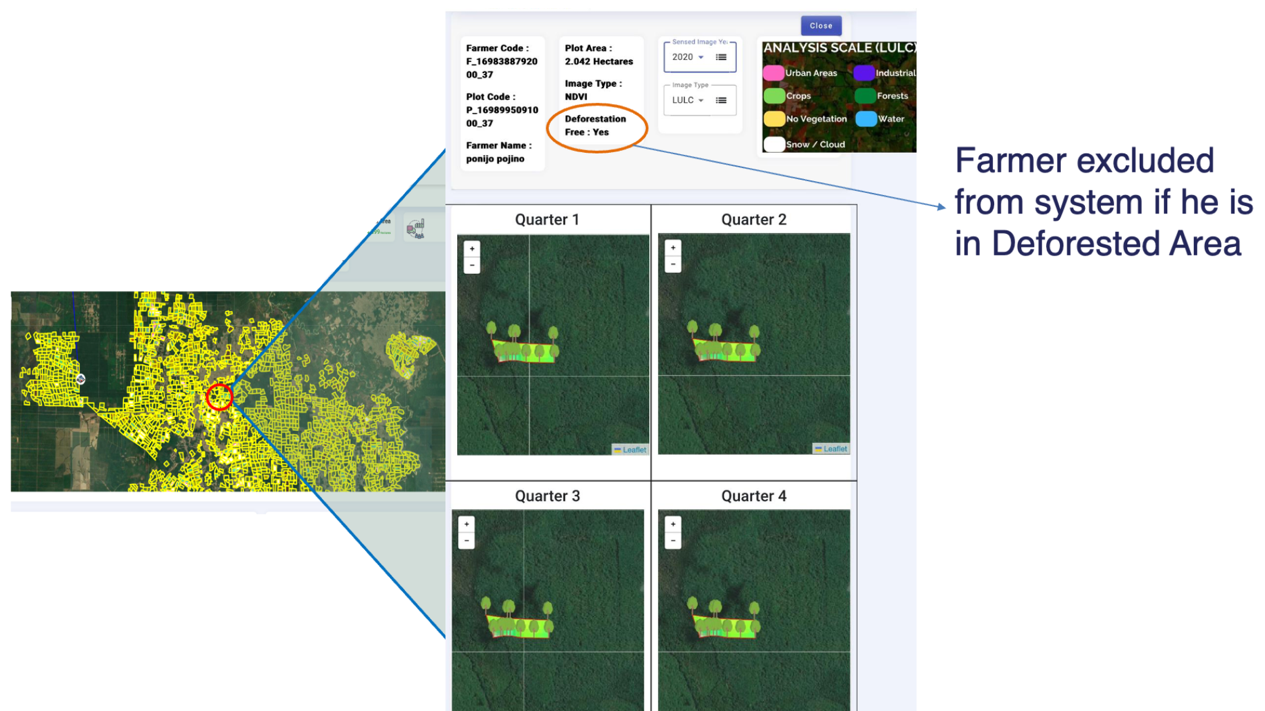
In parallel, every plot polygon undergoes multi-layer satellite deforestation analysis against the 31 December 2020 baseline, using Copernicus Sentinel-2 imagery at 10 metre resolution with a five to six day revisit, across six output layers: NDVI, NDMI, NDWI, land-use and land-cover classification, forest-cut detection and protected-forest overlay. Plots are cross-checked against the WDPA and DOPA protected-area databases and against India-specific datasets from the Forest Survey of India and Bhuvan/NRSC.
Critically, the analysis distinguishes tree-cover loss from deforestation. A canopy-loss alert on an established rubber plantation, caused by harvesting, replanting or seasonal variation, is not deforestation under EUDR, because the regulation treats rubber cultivation as an agricultural plantation rather than forest. BSNR's human-validated, multi-layer approach means screening alerts are investigated rather than blindly reported, which protects compliant farmers from false flags.
Only fully validated records generate the traceability certificate and GeoJSON file an exporter downloads for each shipment. Importers can independently verify plot geolocations through the EU Information System under Article 33 of the regulation.
Results
Live figures from the BSNR platform, July 2026.
Against a national target of 1.2 million farmers and more than 888,000 hectares, this is giving EU buyers a verified, ready-made directory of compliant Indian suppliers.
What the numbers mean in practice
- For Indian exporters and processors. Compliance documentation that once required private agencies and months of effort is generated through a single government-backed system, at no cost.
- For EU importers and buyers. Every Indian counterparty on the platform is verifiable against a national database supervised by a Government of India body, with auditable, defensible traceability records.
- For farmers. Legal recognition, validated land records, and continued access to the market that sustains their livelihoods.
What’s next
EUDR is widely expected to be the first of a wave of similar regulations in the UK, the US, Japan and other major markets. BSNR positions India ahead of that curve. The initiative already reaches beyond regulatory compliance, integrating carbon credits and sustainability metrics to build a global brand for Indian natural rubber as deforestation-free, traceable and competitive. What began as a compliance problem is becoming a national asset.
BSNR also demonstrates that the hardest compliance problems, fragmented supply chains, millions of smallholders and layered intermediaries, are solvable when government coordination meets purpose-built technology. It is a replicable blueprint, for other commodities and for other producing nations facing the same regulatory wave.