How Malawi Turned the Paris Agreement Into a Digital Treasury, Built With TRST01 and the Green Economy Partnership
The Challenge: Climate Commitments Without a System to Prove Them
Under Article 6 of the Paris Agreement, countries are expected to show verifiable progress on their climate commitments, not just file pledges. In practice, most governments still run Monitoring, Reporting and Verification (MRV) through manual, periodic processes: emissions data scattered across ministries and agencies, project verification handled by outside consultants, and carbon transactions tracked on spreadsheets rather than an auditable system of record.
For Global South nations in particular, this creates a structural disadvantage. Building a credible, internationally recognised MRV and registry system from scratch is expensive and technically demanding, putting many countries at a disadvantage when competing for climate finance and Article 6 carbon-market participation, even when their underlying climate assets, forests, restored land, avoided emissions, are real.
- Emissions and land-use data fragmented across ministries, sectors and individual project developers.
- MRV traditionally run as a manual, periodic exercise rather than a continuous, auditable system.
- Building sovereign-grade MRV and registry infrastructure is costly, a high barrier for developing economies.
- Investors and climate financiers increasingly require continuous, audit-ready evidence before committing capital.
Without a trusted digital system linking national climate data end to end, a country's climate action remains a set of claims rather than a verifiable, investable national asset.
Why Verifying an Entire Nation's Climate Action Is Uniquely Hard
- A national climate programme spans many ministries and sectors, each often keeping its own separate records.
- Article 6 and Internationally Transferred Mitigation Outcome (ITMO) transactions demand a level of baselining, transparency and corresponding adjustment that manual systems struggle to sustain.
- Traditional MRV and verification models rely on outside consultants and periodic audits, which is slow and expensive at national scale.
- Financiers need to see impact continuously, tonne by tonne and hectare by hectare, not in a report published once a year.
The Turning Point: A Government Decides to Build Trust Into Its Climate System
Malawi's Ministry of Natural Resources and Climate Change partnered with the Dubai-based Green Economy Partnership (GEP) and TRST01, as GEP's digital system design partner, to build a national digital backbone for climate governance rather than commission another manual reporting exercise. The result, the Paris Agreement Implementation Platform (PAIP), was officially launched on Finance Day at COP30 in Belem, Brazil, on 15 November 2025, alongside the launch of Malawi's Environmental Treasury, the first of its kind in the world.
- Offered free of charge to other Global South governments, removing the cost barrier that normally keeps advanced MRV and registry infrastructure out of reach.
- Built to align directly with Nationally Determined Contributions (NDCs), UNFCCC reporting and Article 6 mechanisms from the outset, rather than retrofitted onto legacy systems.
- Designed with sovereignty in mind: Malawi owns and operates its Environmental Treasury, while GEP and TRST01 built and continue to support the underlying technology.
- AI and blockchain embedded from the ground up, rather than added as an afterthought to existing spreadsheets and manual registries.
The Solution: The Paris Agreement Implementation Platform (PAIP)
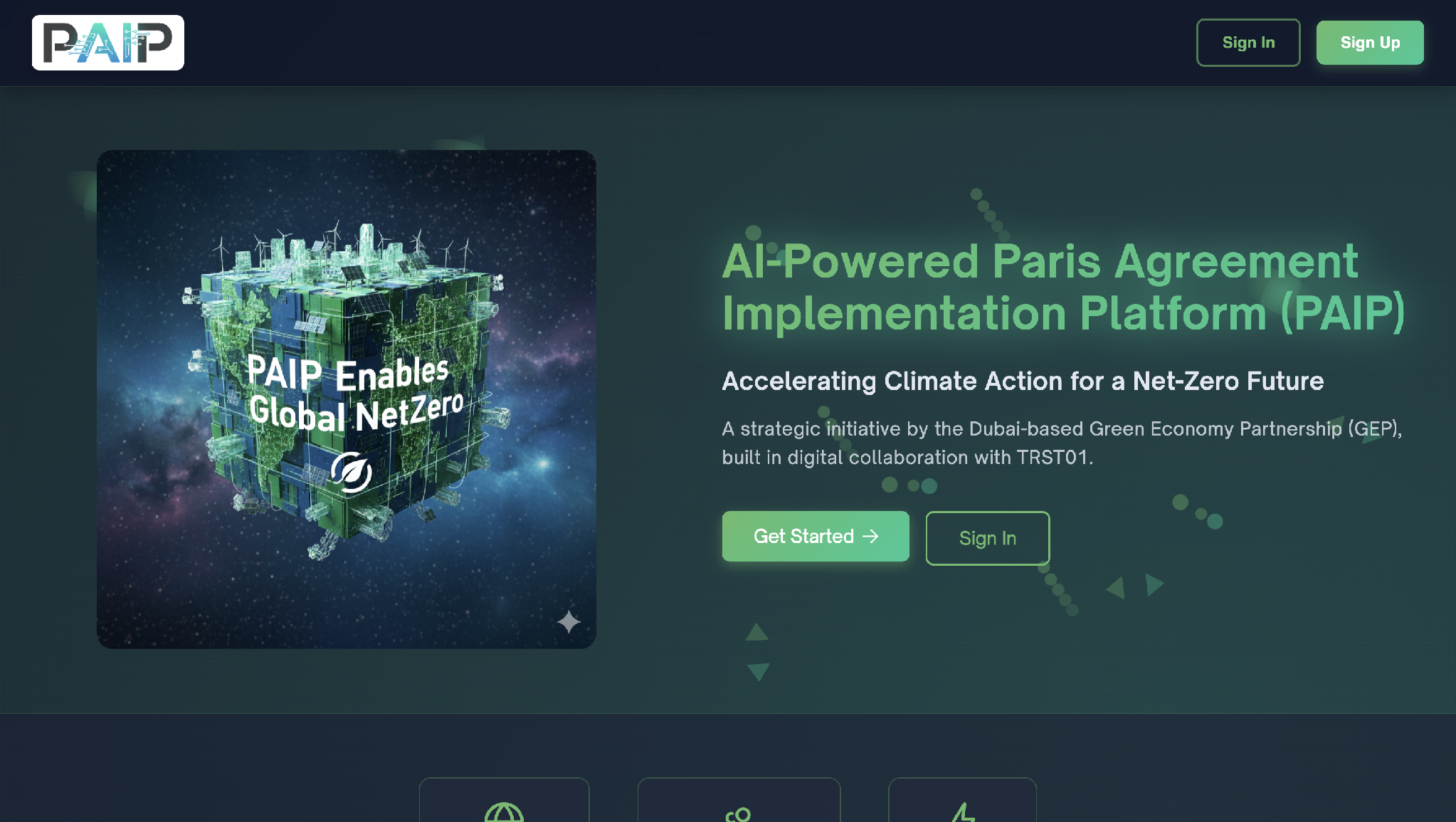
PAIP is an AI-powered climate governance and decarbonisation platform, built by TRST01 as GEP's digital system design partner, that turns Paris Agreement compliance frameworks, NDCs, the Global Stocktake (GST), MRV, Article 6 and sectoral pathways, into automated, auditable workflows for governments, financial institutions and enterprises. In Malawi, it forms the technological backbone of the country's new Environmental Treasury.
- AI-driven interpretation of Paris Agreement compliance frameworks into simple, automated national and sectoral workflows.
- A unified climate data infrastructure that harmonises data from public, private and sectoral sources into one system of record.
- Real-time decarbonisation intelligence: emission hotspots, transition risks and mitigation opportunities surfaced automatically rather than compiled by hand.
- An integrated MRV and climate disclosure engine, with automated templates aligned to international reporting standards.
- AI-assisted emissions calculations across Scope 1, 2 and 3 with sector-specific accuracy.
- Climate finance and Article 6 enablement: crediting mechanisms, transparent baselines and investment tracking designed to accelerate climate-aligned finance.
- A digital trust layer, powered by TRST01, securing every credit and transaction on an immutable public ledger.
End to end, PAIP links every stage of a country's national emissions value chain, inventory, project origination, validation, auctioning, monitoring and retirement, into a single digital ecosystem. As Richard Perekamoyo, Principal Secretary at Malawi's Ministry of Natural Resources and Climate Change, put it, the system lets Malawi “track every ton of CO2 for its efficacy, every hectare restored and the returns in terms of GDP, IRR and jobs of every dollar invested with scientific precision.”
Execution: Malawi's Environmental Treasury
- Launched on Finance Day at COP30, Belem, Brazil, 15 November 2025.
- Malawi is the first country in the world to deploy the platform, using it as the backbone of its newly formed Environmental Treasury.
- The system integrates artificial intelligence, smart contracts, satellite imagery, machine learning models and immutable blockchain infrastructure to monitor emissions and verify climate projects.
- PAIP is being offered free of charge to other Global South nations to accelerate their own Article 6 implementation and lower the barrier to advanced climate technology.
- GEP has announced plans to scale PAIP across Africa, Asia and Latin America from 2026, through its Digital Climate Transformation Program.
The Results So Far
This is a first-of-its-kind national adoption rather than a multi-year track record, so the verified results to date are about what has been built and adopted, not yet about volumes of credits issued or capital raised:
- Malawi became the first nation in the world to launch an AI-driven, blockchain-verified national Paris Agreement implementation platform, reported by more than half a dozen independent international outlets alongside TRST01 and GEP's own announcements.
- PAIP now forms the technological backbone of Malawi's Environmental Treasury, described by GEP's Chief Sustainability Officer as the world's first of its kind.
- The platform unifies national GHG inventory, project origination, validation, auctioning and retirement into one digital ecosystem, replacing what would otherwise be separate, disconnected systems.
- PAIP is positioned as a free, ready-to-deploy blueprint for other Global South governments, with GEP's scale-up across Africa, Asia and Latin America planned to begin in 2026.
No independent, on-the-ground usage figures, credits issued, hectares verified, or capital mobilised, have been published since the November 2025 launch. This section should be revisited once Malawi's Environmental Treasury reports its first operating results.
What this means in practice:
- For Malawi: a route to attracting green capital and unlocking Article 6 investment, backed by audit-ready national climate data rather than a self-reported claim.
- For other Global South governments: a free, ready-to-deploy blueprint that removes the traditional cost barrier to sovereign-grade MRV and registry infrastructure.
- For TRST01: proof that its climate infrastructure operates at full national-treasury scale, not only at the level of an individual carbon or traceability project.
“Track every ton of CO2 for its efficacy, every hectare restored and the returns in terms of GDP, IRR and jobs of every dollar invested with scientific precision, strengthening trust in our national data and results.”
— Richard Perekamoyo, Principal Secretary, Ministry of Natural Resources and Climate Change, Republic of Malawi
“Integrity begins with data. By embedding AI within the national emissions data lake and securing it via blockchain, Malawi has created the world's first Environmental Treasury, a benchmark for transparency and accountability in the Global South.”
— Ivano Iannelli, Chief Sustainability Officer, Green Economy Partnership (and CEO, TRST01 Climate Intelligence)
Malawi's Minister of Natural Resources and Climate Change, Hon. Jean Mathanga, described the launch as a signal that Africa can lead in climate innovation and governance, while GEP's Chief Executive Officer, Arthur Chirkinian, framed PAIP as an open invitation: a tool, offered at no cost, designed to help Global South nations attract Article 6 investment and grow national GDP.
Beyond Malawi: A Blueprint for the Global South
TRST01 and GEP have been explicit that Malawi is meant to be a first mover, not a one-off. GEP's Digital Climate Transformation Program plans to extend PAIP across Africa, Asia and Latin America from 2026, offered at no cost to accelerate Article 6 projects and widen access to advanced climate technology that would otherwise be out of reach for many developing economies. Within TRST01's own account of its Global South work, Malawi sits alongside the Democratic Republic of Congo's national carbon registry as one of two milestones marking a broader shift, in TRST01's words, “from promises to proof, from projects to infrastructure.”
Why This Case Matters
Malawi's Environmental Treasury shows that TRST01's climate infrastructure can operate as the literal backbone of a sovereign treasury, not only as a tool for an individual carbon or traceability project. It sets a precedent for how a government can adopt Article 6-ready digital infrastructure, AI-driven MRV, blockchain-secured registries, investor-facing dashboards, without building it alone or bearing the cost that has historically kept this kind of system out of reach for developing nations. For TRST01, it is a visible, internationally reported example of being the named technology partner behind a national policy launch covered by outlets from India to the UAE to Africa.