How Uttar Pradesh is turning regenerative farming into carbon income for farmers

Challenge
Uttar Pradesh is India’s largest sugarcane state. The districts of Saharanpur and Muzaffarnagar sit at the heart of it, in the fertile Upper Ganga-Yamuna Doab, where Muzaffarnagar is widely known as the Sugar Bowl of India and paddy is a substantial second crop. Agriculture is the backbone of the regional economy, and the state’s priorities are clear: raise farm incomes, restore soil health and build climate-resilient agriculture across millions of smallholdings.
Conventional intensive cultivation works against all three of those priorities. Heavy synthetic fertiliser use drives emissions of nitrous oxide, a greenhouse gas with a global warming potential of 265. Flooded paddy releases methane through the season. Soils lose organic carbon year after year, which in turn erodes yields and pushes input costs up.
Carbon markets should reward farmers for changing these practices, but smallholders have been locked out. Individual holdings are too small to register alone, the cost of conventional Measurement, Reporting and Verification (MRV) is prohibitive at village scale, and paper-based monitoring cannot credibly cover hundreds of thousands of scattered plots to the standard an international registry demands.
The region already had the institutional fabric for scale: cooperative and private sugar mills, sugarcane development societies with deep farmer databases, Farmer Producer Organisations, women’s Self Help Groups and active Panchayati Raj Institutions. What was missing was the digital infrastructure to connect that fabric to a carbon registry: a way to enrol farmers at district scale, verify practice change remotely, and move carbon revenue back to the field transparently, at a cost per hectare the economics of a carbon project can bear.
Approach
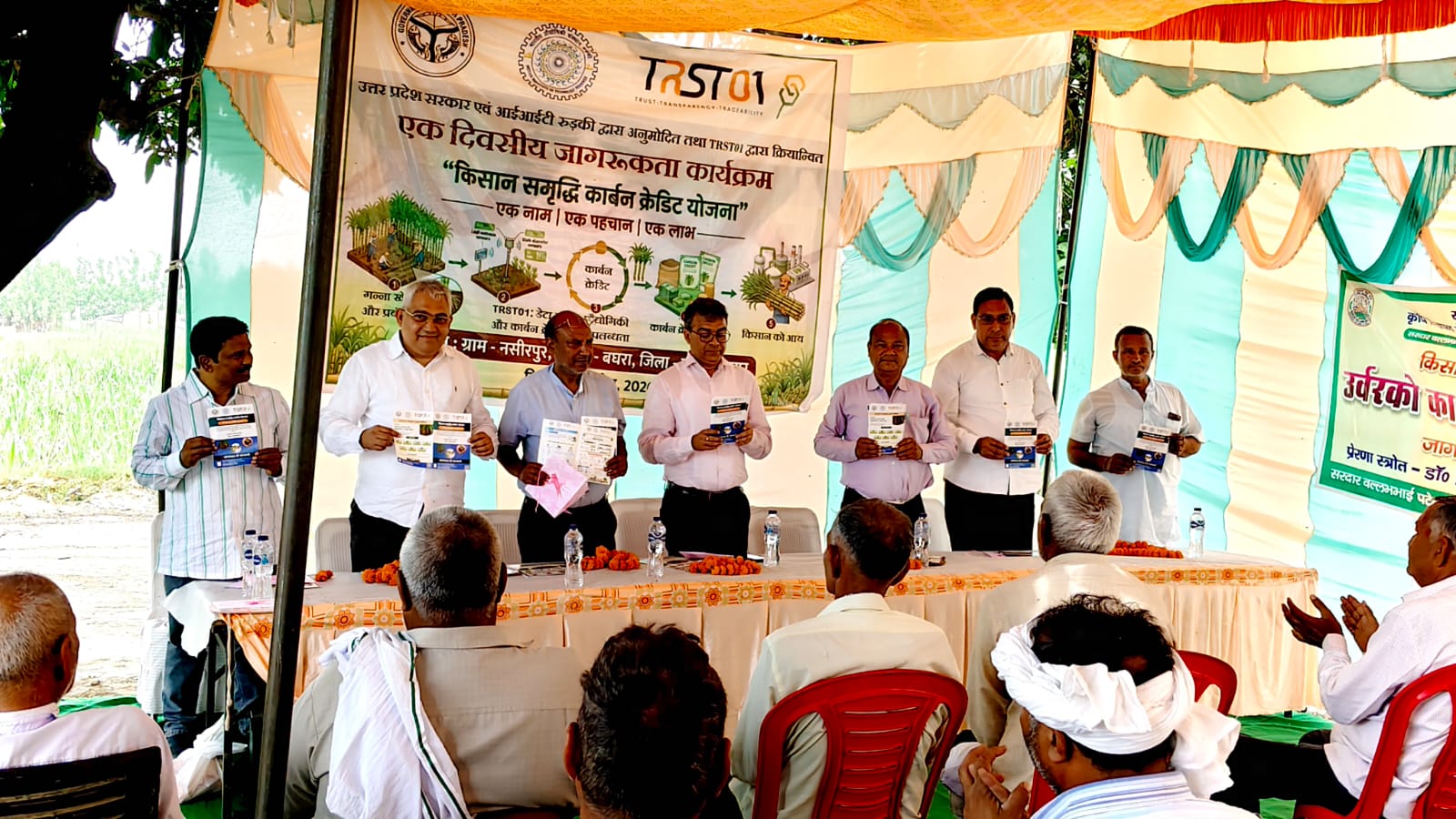
TRST01 designed Kisan Samrudhi as a state-facilitated programme in which the farmer carries no cost and takes no risk, and every existing rural institution has a defined role.
- Consent-based onboarding of farmers of every landholding size, small, marginal and progressive alike, mobilised through village-level awareness programmes, farmer meetings, field demonstrations and digital registration campaigns.
- Institutional aggregation through Farmer Producer Organisations (FPOs) and sugarcane cooperative development societies under the Uttar Pradesh Sugarcane Development Department, whose farmer databases and land records support outreach and verification. Gram Panchayats and Village Development Committees confirm project boundaries and beneficiary lists, anchoring local ownership.
- Digital registration of each farm with Geographic Information System (GIS) boundary mapping, Global Positioning System (GPS) field surveys and a practice baseline, creating a verifiable digital record for every participating plot.
- Regenerative practice packages introduced through continuous field training: optimised and calibrated fertiliser application, organic soil amendments, reduced dependency on synthetic pesticides, and Alternate Wetting and Drying (AWD) in paddy. Women’s Self Help Groups (SHGs) lead household-level adoption, community composting and nursery development.
- Skill development and agronomy support delivered to farmers at no cost, with IIT Roorkee providing project guidance, the Directorate of Sugarcane Development contributing field knowledge, and Krishi Vigyan Kendras and extension officers supporting training on the ground.
- The project registered with Verra under methodology VM0042 v2.2 for Improved Agricultural Land Management, covering 500,000 hectares across the two districts, with scale-up planned in three phases.
Solution
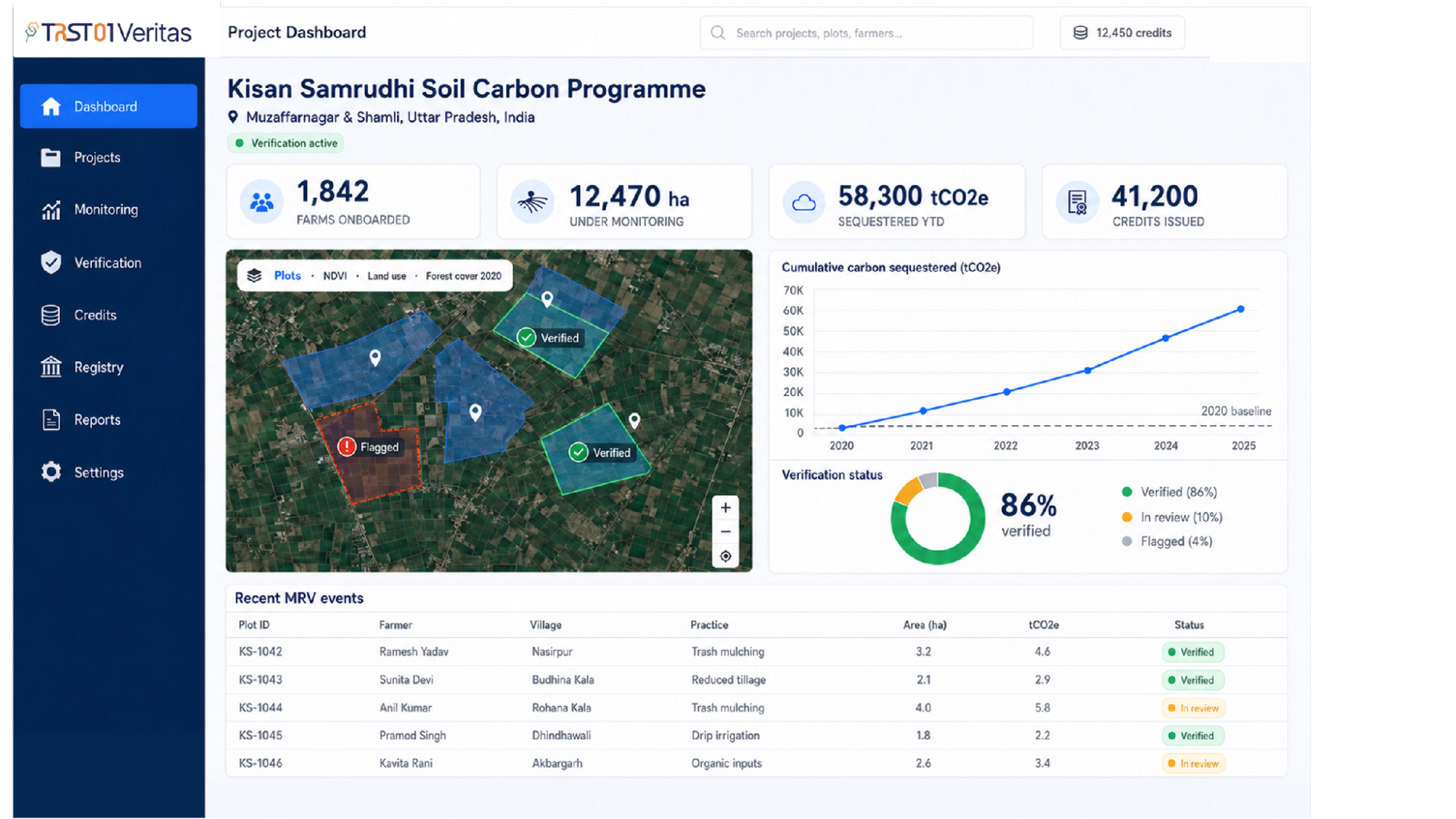
TRST01Veritas runs the programme’s measurement and money trail as one system, built so that the evidence base scales with the landscape instead of with the audit budget.
- Satellite remote sensing and artificial intelligence verify practice adoption and monitor soil organic carbon indicators across the full project area, replacing periodic manual audit as the primary evidence base and covering every enrolled plot rather than a sample.
- Mobile field applications capture farmer details, consent records, cropping data and ground-truth observations that calibrate and validate the remote analysis.
- Blockchain-anchored records create a tamper-evident trail from individual farm to registry, so every Verified Carbon Unit (VCU) traces back to named fields, dates and practices.
- Audit-ready datasets are generated continuously for validation and verification bodies, shortening the path from field activity to credit issuance under the Verra process.
- Benefit-sharing rails route 50 percent of carbon credit sale revenue directly to participating farmers, with programme dashboards giving the state government and partners live visibility of enrolment, practice adoption and benefit flows.
For an individual farmer the experience is deliberately simple: register with consent through a local institution, adopt the practices with free training and support, and receive a direct share of the carbon revenue the verified change generates. The soil improves, input costs fall, yields are maintained, and a new income line appears, none of it paid for by the farmer.
This initiative gives farmers a meaningful stake in climate action by ensuring that their sustainable practices translate into real and measurable income.
— Prof. K. K. Pant, Director, IIT Roorkee
Results
What’s next
Phase 1 mobilisation is underway, with enrolment building through FPOs, cooperative societies and village institutions toward full coverage of the 500,000 hectare project area over three phases. As adoption deepens, the dMRV infrastructure extends naturally to adjacent crediting mechanisms, including methane-focused AWD paddy crediting measured through the field water regime.
Beyond the two districts, the programme is built as a template: the same combination of state facilitation, institutional aggregation and digital verification can be replicated across other sugarcane and paddy regions of India, and positions participating landscapes for both international voluntary markets and India’s developing domestic carbon market.
SOLUTION USED
TRST01Veritas dMRV, Kisan Samrudhi Carbon Credit programme
Building a state or institutional carbon programme? Talk to the team that built this one.
Dr Susant Barik, Project Director: susant.b@trst01.com · Prabir Mishra, TRST01: prabir@trst01.com