
TRST01 Signs Aroma Natural Rubber, Its First Sri Lankan Client, for EUDR Traceability

November 2026 · Colombo and Hyderabad
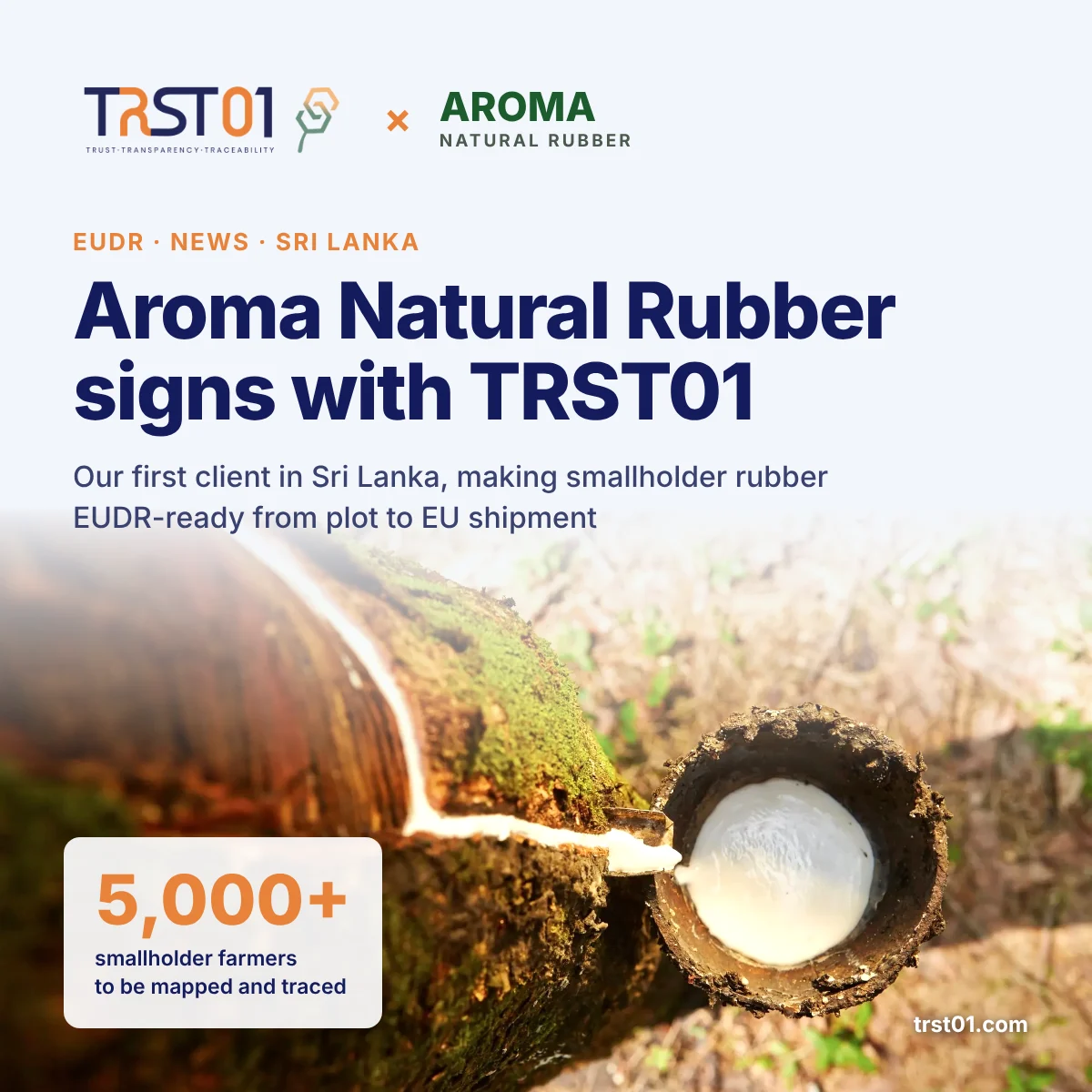
TRST01 has signed an agreement with Aroma Natural Rubber, a Sri Lankan natural rubber manufacturer, to make its supply chain ready for the EU Deforestation Regulation (EUDR). Aroma is TRST01’s first client in Sri Lanka.
The work covers more than 5,000 smallholder farmers who supply Aroma. TRST01 will map their plots, check them for deforestation, and carry that proof through collection, processing and export, so that every EU-bound shipment leaves with the data its buyers need for their Due Diligence Statements.
Aroma’s directors, Mr. Nifkhan, Mr. Nafees and Mr. Arkam Najeeb, chose TRST01 for the simplicity of its solution, and for a track record proven with the Rubber Board of India and with clients across several countries.
Why EUDR traceability matters for Sri Lankan rubber
Sri Lanka planted its first rubber seedlings in 1876, and much of its rubber today comes from smallholders. The EUDR applies to large and medium operators from 30 December 2026, and to micro and small enterprises from 30 June 2027. Natural rubber and many rubber products are in scope. For every consignment, EU buyers must be able to show:
- the geolocation of every plot that produced the rubber;
- that no deforestation or forest degradation took place on those plots after 31 December 2020;
- that the rubber was produced legally under Sri Lankan law; and
- a Due Diligence Statement filed in the EU Information System.
Smallholder rubber is among the hardest supply to trace. It is collected from thousands of small plots, often through dealers and collection centres, and blended before processing. Without records at the point of purchase, the link to the plot is lost before the rubber reaches the factory.
What TRST01 will do for Aroma
- Farmer and plot mapping: GeoJSON boundaries for each supplying smallholding, captured on offline mobile apps.
- Deforestation and legality checks: satellite analysis of every mapped plot against the 31 December 2020 baseline.
- Collection-to-factory traceability: purchases recorded against the farmer and plot, so each processing batch keeps the list of plots that went into it.
- DDS-ready data: consolidated GeoJSON and due diligence data for each EU-bound shipment, which buyers can file through EUDR Hub.
The approach draws on TRST01’s work with the Rubber Board of India on BSNR (Bharat Sustainable Natural Rubber), the national EUDR traceability platform for Indian natural rubber.
“Sri Lanka’s rubber has been trusted around the world for well over a century. Under the EUDR, that trust now has to be proven, plot by plot. We thank Aroma’s directors for their trust, and we are proud to start our work in Sri Lanka with more than 5,000 smallholder farmers, using the same approach we have taken with the Rubber Board of India,” said Prabir Mishra, Founder and CEO, TRST01.
About TRST01
TRST01 builds supply chain traceability, ESG and carbon infrastructure for businesses and governments. Its platforms, TRST01Chain, Footprint and Veritas, are used by more than 200 organisations for EUDR compliance in rubber, coffee and soy. Learn more about EUDR compliance software for rubber and tyres.







