How TRST01 Brings Digital MRV to AWD
The Challenge: Water-Hungry Rice Farming Meets a Carbon-Constrained World
Traditional paddy cultivation keeps fields continuously flooded from transplanting to near harvest. It is a method farmers have relied on for generations, but it is also extraordinarily water-intensive and a significant source of methane, a greenhouse gas far more potent than carbon dioxide over the short term. India, already a water-stressed country, is estimated to use around 60% more water in paddy cultivation than the crop requires.
For smallholder farmers, this creates a difficult loop: rising input costs, falling water tables, and no direct financial reward for adopting more efficient practices, even when those practices exist and work. For the climate system, it means one of the world's largest staple crops keeps emitting far more than it needs to, with no credible way to measure, let alone monetise, an improvement.
- An estimated 60% excess water use in conventional paddy cultivation in India.
- Continuously flooded soil is a major source of methane emissions from agriculture.
- Farmers bear rising fertiliser and water costs with no financial upside for changing practice.
- No trusted, auditable way existed to prove that a change in on-farm practice actually reduced emissions.
The stakes were straightforward: without independent, field-level proof, water-saving and methane-reducing practices such as Alternate Wetting and Drying (AWD) would remain good agronomy, but never a creditable climate outcome that could be verified or paid for.
Why Verifying Farm-Level Carbon Is Uniquely Hard
- Paddy is grown across millions of small, scattered plots with no existing digital record of irrigation practice.
- The emissions reduction happens underground, in soil chemistry, and is invisible without continuous field-level monitoring.
- Carbon markets require rigorous, auditable measurement, not self-reported estimates.
- Individual smallholders have neither the capital nor the technical capacity to run monitoring, reporting and verification (MRV) themselves.
Without a shared digital layer connecting field practice to a verifiable record, every farmer's water saving would stay a private, unprovable claim.
The Turning Point: Bringing Digital MRV to an On-the-Ground AWD Programme
TRST01 partnered with a field-delivery organisation already working directly with paddy farmers in Telangana to run Project VARRI, an Alternate Wetting and Drying programme. TRST01's role in the partnership is the digital layer: measuring, reporting and verifying what AWD actually achieves in the field, so that a change in irrigation practice can be turned into a credible, auditable climate record rather than an anecdotal claim.
- Farmer-first economics: the technology used to measure water savings should not add cost or complexity for the farmer.
- Science-based measurement designed to meet the rigour that credible carbon markets require.
- Transparent tracking from field data capture through to a verifiable record, rather than a one-time estimate.
The Solution: Project VARRI, Backed by TRST01's Digital MRV
AWD replaces continuous flooding with controlled, intermittent irrigation cycles. TRST01's digital MRV layer sits underneath the farming practice itself, capturing and verifying what is actually happening at field level so that the water and emissions benefits of AWD can be measured rather than assumed.
- Farmer enrolment and plot-level data capture across the AWD programme area in Telangana.
- Continuous digital Measurement, Reporting and Verification (dMRV) tracking irrigation cycles and the resulting emissions reduction estimate.
- AI and blockchain-driven data pipelines, in line with TRST01Veritas' broader approach, to reduce the risk of double-counting or unverifiable claims.
- A field-level system designed to meet the rigour independent carbon standards expect from a certifiable programme.
The intent is that by the time an emissions reduction is claimed under Project VARRI, it is backed by a continuous digital record of what happened in the field, not a self-declared estimate submitted after the season ends.
Scale and Targets
- TRST01 has stated a target of bringing 50,000 hectares under Project VARRI by the end of 2023, scaling to 2,50,000 hectares by the end of 2026.
- The programme coverd approximately 10,000 acres under Alternate Wetting and Drying already.
The Results So Far
TRST01's published methodology for this programme:
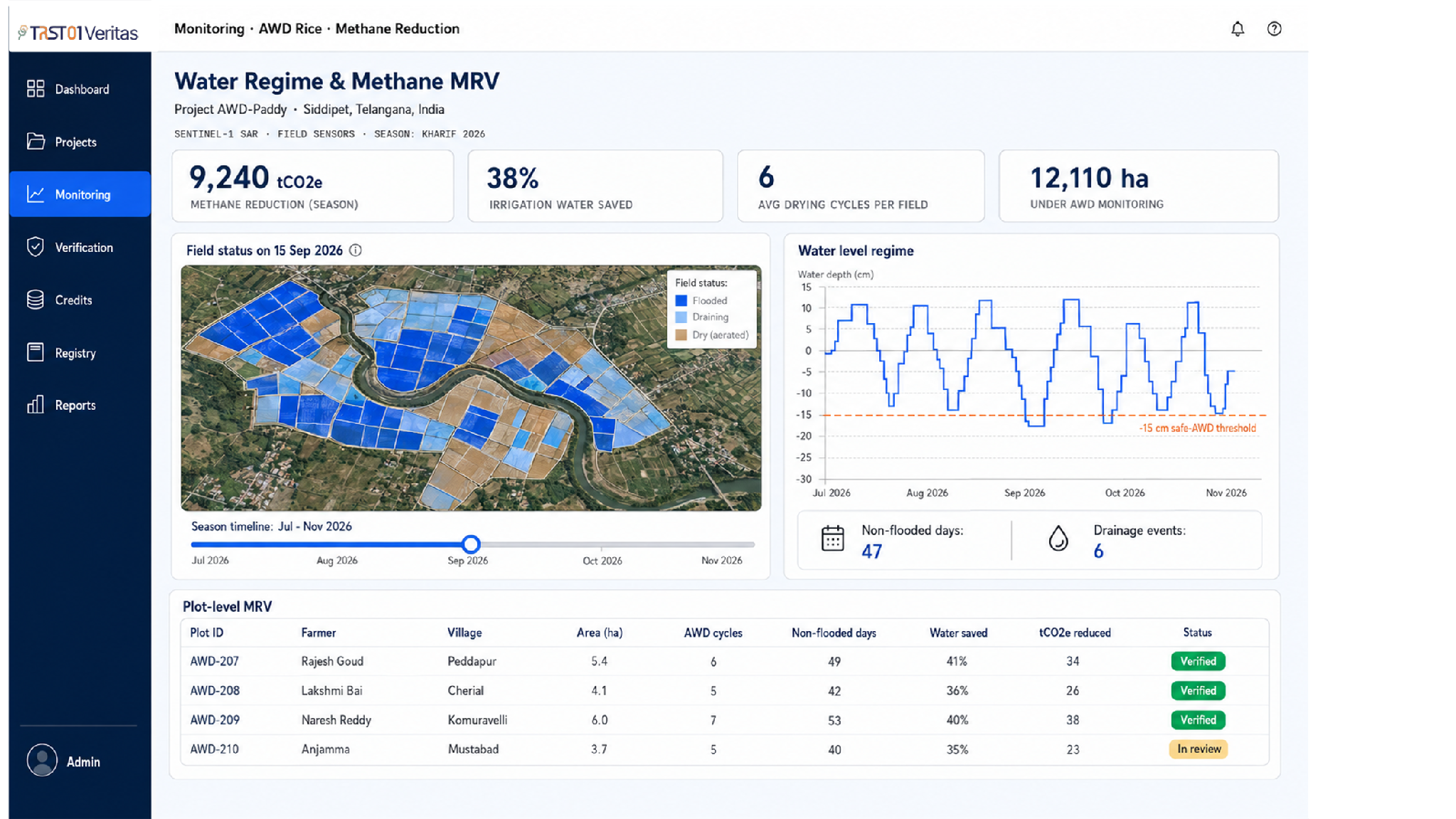
- Up to 40% water savings per hectare through AWD, against conventional flooded cultivation.
- 4 to 5 tonnes of CO2-equivalent emissions reduced per hectare through AWD.
- A stated scale-up path from 50,000 hectares (end of 2023) to 2,50,000 hectares (end of 2026).
- Approximately 10,000 acres of paddy land referenced as under AWD-based carbon accounting by TRST01's own sustainability team, per public professional profiles.
What this means in practice:
- For farmers: a path to measurable water and input savings, with the groundwork laid for future carbon-linked income once a change in practice can be verified.
- For carbon buyers and partners: a measurement approach built on continuous field data and digital verification rather than a one-time estimate.
- For TRST01: a working example of applying TRST01Veritas' dMRV approach at the level of an individual farmer's field, not just a national platform.
Beyond This Programme: A Template for Water-Stressed Agriculture
Rice is among the most water- and methane-intensive staple crops grown at scale, and Telangana is one of many rice-growing regions worldwide facing the same water-stress and emissions trade-off. Project VARRI shows that pairing a water-saving irrigation practice with a rigorous digital MRV layer underneath it can turn an invisible practice change into something that can, in principle, be measured and verified rather than simply asserted.
Why This Case Matters
Project VARRI demonstrates that digital MRV does not only belong in large government platforms or industrial supply chains. Applied at the level of an individual farmer's field, it can turn a water-saving habit into data that a carbon market or a buyer can actually trust, standing in for the paperwork trail no smallholder could realistically keep. It is a template for any water-intensive crop, in any geography, where the practice change is real but has so far gone unmeasured.