
Good Produce, Rejected Anyway
Why Export Shipments Fail at the Border
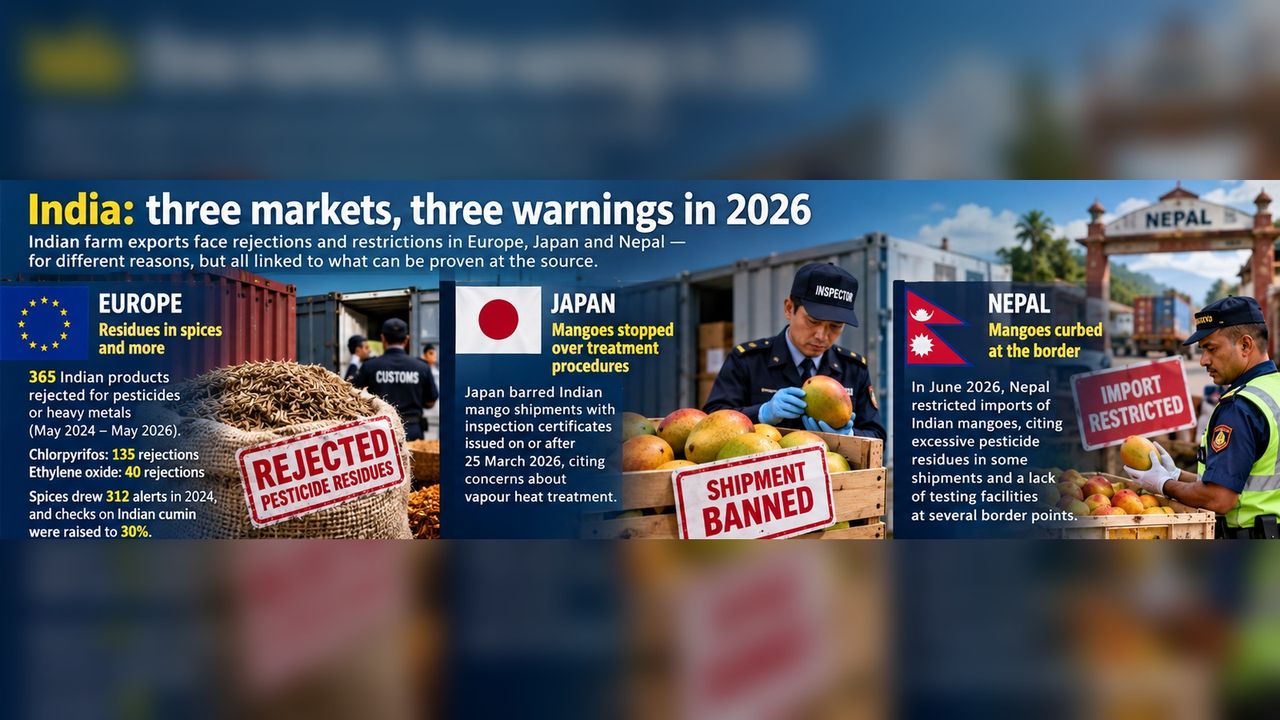
India: three markets, three warnings in 2026
In 2026, Indian farm exports were turned away or restricted in markets near and far, each time for a reason that comes back to records at the source. India is one of the world’s most experienced food exporters, which makes the lesson hard to ignore.
Europe: residues in spices and more. Between May 2024 and May 2026, 365 Indian products were rejected in the EU for pesticides or heavy metals, and 50 more for pathogens. Chlorpyrifos alone accounted for 135 of them, and ethylene oxide for 40.[1]Spices drew 312 alerts on the EU’s rapid alert system in 2024, and checks on Indian cumin were raised to 30% of consignments.[2]
Japan: mangoes stopped over treatment procedures. After Japanese inspectors visited Indian facilities in March 2026, Japan barred Indian mango shipments with inspection certificates issued on or after 25 March, citing concerns about vapour heat treatment.[2] It was the first major disruption in nearly two decades; an earlier ban ran from 1986 to 2006.[2] This was not about residues at all, but about whether the treatment process could be proven to meet Japan’s standards.
Nepal: mangoes curbed at the border. In June 2026, Nepal restricted imports of Indian mangoes during the peak season, citing excessive pesticide residues in some shipments and a lack of testing facilities at several border points.[3] Even a neighbour with an open border and close trade ties can close the door when it cannot trust what is coming in.
Three markets, three different rules: a residue limit in Europe, a treatment protocol in Japan, a border test in Nepal. In each case, an exporter who could show farm level spray records and process records for every lot would have been in a far stronger position.
Rwanda: five tonnes of chilli, destroyed
In March 2026, five tonnes of Rwandan chilli shipped to Italy were rejected and destroyed.[4]
It was not the first time for Robert Rukundo, who chairs the Horticulture Exporters Association of Rwanda. In 2025, two tonnes of his chilli were rejected in Switzerland, and destroying them alone cost about €4,000. A tonne of chilli is worth around $5,000 once production and transport are counted.[4]
The problem was not something anyone could see: pesticide residues that the buyer’s market does not allow. This is the most common reason good produce fails at a border, and it is almost always a traceability problem in disguise.
The invisible problem
Every importing market sets maximum residue levels, the highest amount of a pesticide allowed on a food. These limits are set per substance and per crop, and they differ from country to country. In the EU, when a pesticide has no specific limit for a crop, a very strict default of 0.01 mg/kg applies, which in practice means almost none at all.
Recent EU notifications on Rwandan peppers and chillies named substances such as acetamiprid, chlorpyrifos and carbendazim.[4] The core issue, as Rwandan officials explain, is that inputs permitted at home may be banned or limited in the destination market. “Using inputs not permitted in a particular destination can result in entire consignments being destroyed,” said Claude Bizimana, CEO of Rwanda’s National Agricultural Export Development Board (NAEB).[4]
Rwanda is not alone. In EU testing of 2022 samples, imported food exceeded legal residue limits about four times as often as food produced in the EU. The examples named included chlorpyrifos in rice and cumin seeds from India and in oranges from Egypt.[5]
One rejection becomes everyone’s problem
When problems repeat, the EU places a product from a specific country under temporary increased official controls, meaning more shipments are stopped and tested at the border.[6] The January 2026 update, Implementing Regulation (EU) 2026/194, applies from 18 February 2026.[7]
Under that update, capsicum peppers from Rwanda and Thailand now face more frequent checks for pesticide residues. Seam and helmet beans from Bangladesh face more checks, and strawberries from Egypt were added to the list.[6] For the most serious cases, every consignment must be tested in a laboratory and officially certified before it even leaves the exporting country.[6]
This means one careless farm can raise costs and delays for every exporter of that crop in that country. The good news works the other way too. In the same update, several Indian products, including nutmeg, vanilla, cloves, okra and peppers, were taken off the list of increased controls.[6] A clean record earns lighter checks.
Why good shipments still fail
Most rejected exporters did not set out to break any rules. The common causes are ordinary:
The wrong product at the local shop. A pesticide sold legally at home may contain an ingredient that the destination does not accept. Rukundo pointed to products commonly sold to farmers that “often contain ingredients that are not accepted in some markets.”[4]
Spraying too close to harvest. Even an approved product can leave too much residue if the waiting period between spraying and harvest is ignored.
One farm in a mixed lot. Exporters often buy from dozens or hundreds of smallholders and pack everything together. If one farm used the wrong product, the whole consignment fails, and nobody knows which farm it was.
Old residues and drift. Residues can come from earlier pesticide use in the soil or drift from a neighbour’s field.[5]
Testing too late. A lab test on the final lot finds the problem only after the produce has been harvested, packed and paid for.
What traceability changes
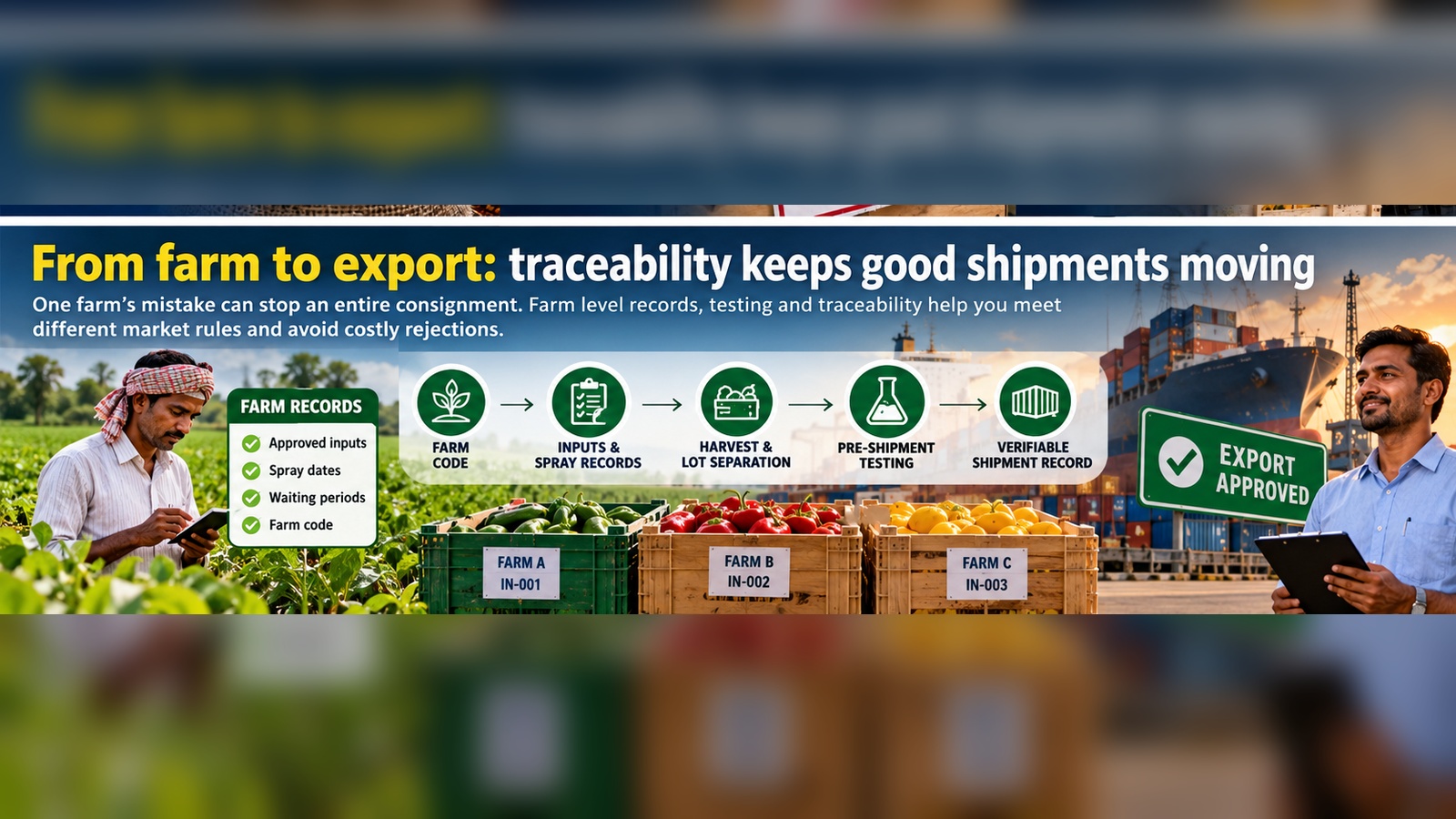
Rwanda’s response is instructive. NAEB and the Rwanda Inspectorate, Competition and Consumer Protection Authority (RICA) are rolling out a traceability drive built on farm codes. Each production site gets a code, so every box can be linked back to the farm it came from.[4]
Farms are even registered by destination: chilli grown for the UK comes from different coded land than chilli for other markets, so farmers can follow the right rules for each buyer. Packhouses and orchards are registered too, and production history and pest monitoring are recorded. The drive covers avocado, French beans, fresh chilli and macadamia, and 121 avocado orchards have already been coded, with four packhouses registered for export.[4]
This approach has worked before. India’s grape exporters introduced farm registration and residue monitoring in the 2000s; by 2011 and 2012 their EU border rejections had fallen to zero, while exports grew from 11,000 to 37,000 tonnes between 2002 and 2012.[8]
With farm codes, a residue problem stops being a mystery. The exporter can find the farm, hold back its produce, fix the cause with that farmer, and ship the rest. That is the difference between losing one farm’s harvest and losing a whole consignment.
Five things to do before your next shipment
1. Know the rules of each destination. Check the residue limits for your crop in every market you ship to. The EU, UK, Gulf and Asian markets can differ.
2. Give farmers a destination input list. Turn those rules into a simple list of approved products and waiting periods for each market, and share it with every farmer who supplies you.
3. Register and code every farm. Give each supplying farm a code and record it on every crate, so each lot can be traced back.
4. Keep spray records. Record what was sprayed, on which field, and when. These records are your first line of defence if a shipment is questioned.
5. Keep lots separate and test smartly. Avoid mixing farms without records, and test high risk farms before harvest, not just the final lot. Link each lab result to the farm code.
The bigger pattern
This series has followed traceability from forests to steel furnaces to fishing boats. Here the case is the simplest of all. When a shipment fails, the cost is not a fine or a form. It is the whole consignment, destroyed.
The answer is the same as before: know the first point of production, and keep every lot linked to it. For fresh produce, that means knowing which farm grew what, and how.
At TRST01, we build traceability infrastructure that links farms, inputs, harvests and shipments into one verifiable record, so exporters can prove compliance before their produce leaves the country. Learn more at trst01.com.
Subscribe to the TRST01 Weekly Newsletter on Traceability for a plain language update every week on the rules shaping global trade. Share this with a fresh produce exporter who needs to see it.
References
[1] WION, “India’s agri export crisis: mango, rice, spice, a bigger pattern of compliance failure” (9 June 2026). https://www.wionews.com/india-news/india-agri-export-crisis-nepal-japan-china-compliance-failures-1780993466741
[2] Al Jazeera, “Why have several nations raised red flags over Indian farm exports?” (12 August 2026). https://www.aljazeera.com/news/2026/8/12/why-have-several-nations-raised-red-flags-over-indian-farm-exports
[3] National Herald, “Nepal curbs Indian mangoes over pesticide issues, boosting local growers” (9 June 2026). https://www.nationalheraldindia.com/national/nepal-curbs-indian-mangoes-over-pesticide-issues-boosting-local-growers
[4] allAfrica / The New Times, “Rwanda: New traceability drive seeks to protect horticulture exports” (13 September 2026). https://allafrica.com/stories/202609140048.html
[5] Euronews, “Excess pesticide residues fourfold higher in imported food, agency finds” (24 April 2024). https://www.euronews.com/health/2024/04/24/excess-pesticide-residues-fourfold-higher-in-imported-food-agency-finds
[6] AGRINFO, “Temporary increased official controls on foods from certain countries: January 2026 update”. https://agrinfo.eu/book-of-reports/temporary-increased-official-controls-on-foods-from-certain-countries-january-2026-update/
[7] EUR-Lex, Commission Implementing Regulation (EU) 2026/194. https://eur-lex.europa.eu/legal-content/EN/TXT/HTML/?uri=OJ%3AL_202600194
[8] New Food Magazine, “Fresh produce rejections at EU border inspection posts” (4 November 2013). https://www.newfoodmagazine.com/article/12322/fresh-produce-rejections-at-eu-border-inspection-posts/