.svg)
Pashu Aadhaar to the Ghee Jar
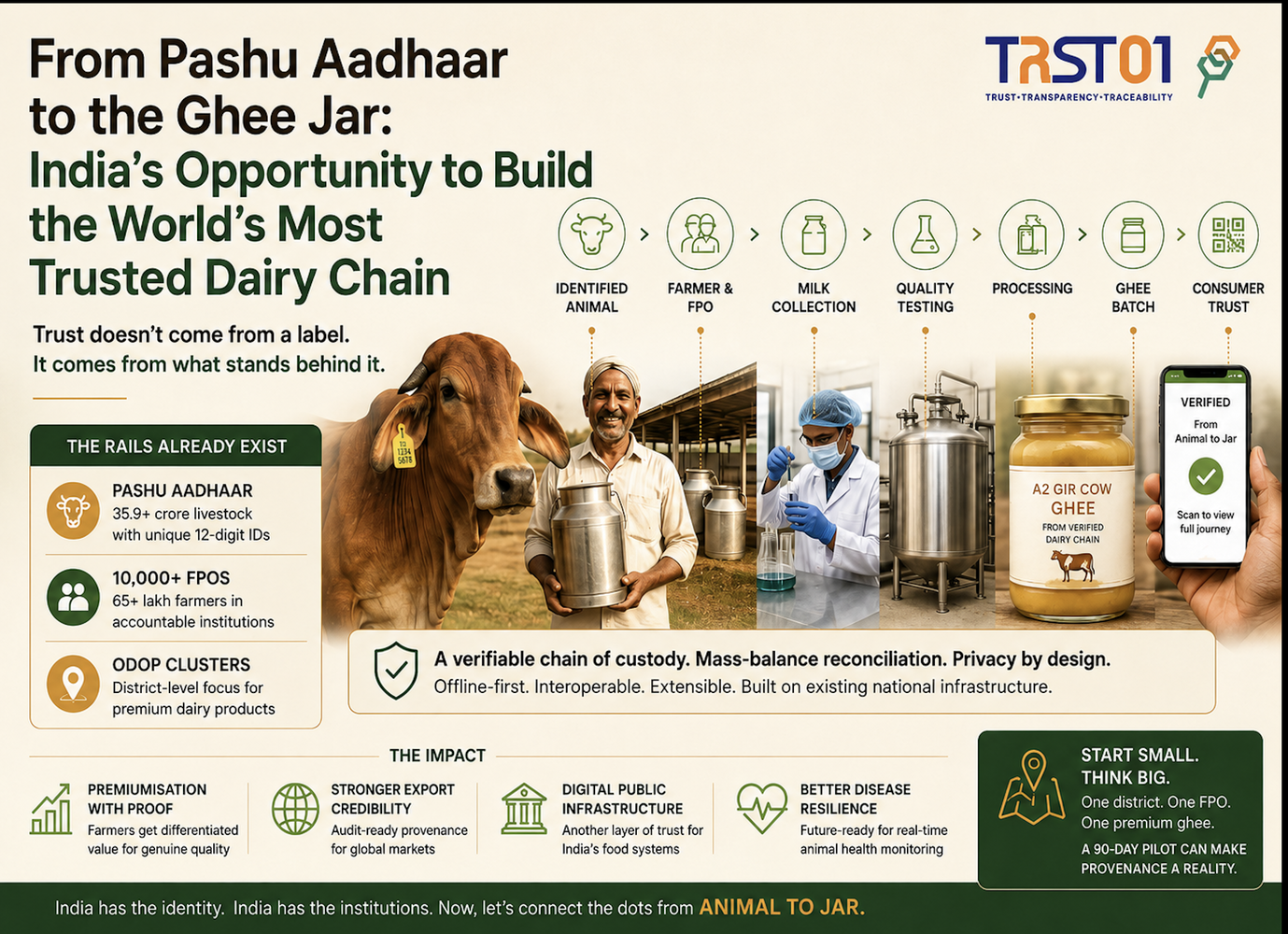
India has a trust problem in its most sacred food. In a LocalCircles survey, six in ten urban households said they lack confidence in the purity and quality of the ghee they buy. Their scepticism is well founded. The Tirupati laddu episode revealed that the temple had received adulterated ghee for over five years before the CBI detained four people. In Bengaluru, an interstate fake Nandini ghee racket was busted with four held and goods worth about ₹1.26 crore seized, and a probe launched into the possible use of animal fat. In June 2026, FSSAI seized over 6,500 litres of suspected adulterated ghee in Delhi and Haryana, months after 6,500 kg was seized in Gujarat.
Every such headline taxes the honest producer and the paying consumer alike. And the instinctive industry response — printing a QR code on the pack — misses the point. A QR code that merely links to a brand page proves nothing. Trust does not come from a label; it comes from what stands behind the label.
The scale, and the premium paradox
India is the world's largest milk producer, contributing roughly a quarter of global output, with dairy anchoring nutrition and income for tens of millions of smallholder households. At the top of this market sits a fast-growing premium segment: the India A2 ghee market is projected to grow at about 25% annually through 2032, driven by health-conscious consumers willing to pay several times the price of ordinary ghee for milk from indigenous breeds like the Gir cow.
Here lies the paradox. The premium rests entirely on claims the consumer cannot verify — which cow, which breed, which farm, what process. When a ₹3,000-a-litre product and a ₹600-a-litre product look identical in the jar, adulteration is not an anomaly; it is the economically rational outcome of an unverifiable market.
The rails already exist
Three national programmes have, almost unnoticed, laid the rails for farm-to-jar trust:
Pashu Aadhaar. Under the National Digital Livestock Mission, India has issued more than 35.9 crore (359 million) Pashu Aadhaar identities — 12-digit unique IDs carried on tamper-proof ear tags and recorded in the INAPH database, covering breed, health, vaccination and ownership. It is the largest livestock identification programme on earth: the first link of any dairy chain — the animal itself — already has a verifiable digital identity.
10,000 FPOs. The Government's flagship scheme has formed over 10,000 Farmer Producer Organisations covering more than 65 lakh farmers — natural, accountable institutions for collection, segregation, testing and processing.
ODOP. The One District One Product programme gives district-level focus and market support Auraiya in Uttar Pradesh, for instance, is identified with dairy processing and desi ghee, a ready cluster for a farmer-led premium ghee value chain.
What is actually needed
What is missing is the connective tissue between these rails and the jar on the shelf: a verifiable chain of custody. Not a certificate, not a logo, not a QR code pointing to a website — but an unbroken, tamper-evident record that follows the milk from an identified animal and a consenting farmer through every hand-off, transformation and test, until it reaches the consumer's hand. Done right, it must reconcile what was produced against what was sold — so that no more "premium" ghee can ever be released than the registered herds can plausibly supply — while fiercely protecting what should stay private: the farmer's personal and financial information. It must work offline in villages, ride on existing national registries like Pashu Aadhaar rather than duplicate them, stay open and auditable rather than locked to any vendor, and be extensible to what comes next, such as IoT-based real-time animal-health monitoring.
That combination — national identity rails, institutional custody, mass-balance economics and privacy by design — is a system-design problem. It is precisely the problem TRST01 has spent years solving.
TRST01™ has the structure and the track record
TRST01™ is a Hyderabad-based sustainability technology company building agricultural traceability, compliance and digital public infrastructure, with the field experience to match the architecture:
- Natural rubber: Technology partner to the Rubber Board of India for the iSNR platform — plantation geolocation, supply-chain operator tracking and EUDR due-diligence documentation, with deployments across Indonesia, Malaysia, Thailand, Vietnam, Laos and Côte d'Ivoire.
- Coffee: Farm-to-export traceability with the Karnataka Planters' Association and exporters such as Hangal Coffee — origin verification, chain of custody and EUDR compliance.
- Soy: Helped SOPA prepare India's non-GMO soybean value chain for EUDR and European market access.
- GI protection: Built the blockchain provenance record that helped Tandur Red Gram secure its GI tag — a template for every GI food product in India.
- Digital public infrastructure: Developed the World Bank-commissioned Open AgriTrace Stack, a national blueprint for agricultural traceability built on interoperable registries, verified identities and governed data exchange.
- Proven scale: TRST01 platforms have digitally mapped over 250,000 hectares for more than 150,000 smallholders across India, Southeast Asia and West Africa, producing audit-ready records for international buyers.
Dairy is the natural next chapter. The same structure that satisfies European regulators on deforestation, and GI registries on provenance, is what Indian dairy needs to satisfy its own consumers on purity and TRST01™ has already designed it for an FPO-led A2 ghee network in an ODOP dairy district, anchored on the cows' existing Pashu Aadhaar identities.
Why this is an India-scale opportunity
- Premiumisation with proof. Verified provenance converts the A2 premium from a leap of faith into a defensible price — and lets the premium flow back to the specific farmer and FPO that earned it, through transparent, quality-linked payments.
- Export credibility. Global buyers increasingly demand audit-ready provenance; India's rubber, coffee and soy sectors are already living this under EUDR. Dairy is next in line, and a Pashu Aadhaar-anchored chain of custody is exactly the evidence layer export markets will ask for.
- Digital public infrastructure. India built identity rails for people (Aadhaar), payments (UPI) and now livestock (Pashu Aadhaar). Verifiable dairy provenance is the natural next layer of the stack — not a proprietary product, but infrastructure any cooperative, FPO or brand can plug into.
- Disease resilience. India's lumpy-skin-disease experience showed why animal-level digital identity matters for disease control; connecting that identity to the food chain, with optional real-time IoT health monitoring, makes the whole system safer.
The 90-day proof talk to us jouney@trst01.com
None of this needs to wait for a decade-long national programme. One district. One FPO. One premium SKU. In 90 days, ghee lots can carry verifiable provenance that auditors, buyers and consumers can check in minutes.That is the pilot TRST01™ has designed for an ODOP ghee cluster — at zero cost to the anchor enterprise.
For dairy brands and FPOs, this is a chance to turn provenance into consumer trust, premium positioning and stronger market access. India has given its cattle digital identity. Now it is time to give every jar a verifiable ancestry from animal to jar.References
- LocalCircles — 6 in 10 urban households lack confidence in purity & quality of ghee
- Deccan Herald — TTD received adulterated ghee for over 5 years: SIT
- Deccan Herald — CBI detains 4 in Tirupati laddu ghee adulteration episode
- Deccan Herald — Interstate fake Nandini ghee racket busted in Bengaluru; 4 held with goods worth ₹1.26 cr
- Cobrapost — Fake Nandini ghee racket: probe into possible use of animal fat
- ANI — FSSAI seizes over 6,500 litres of suspected adulterated ghee in Delhi, Haryana (June 2026)
- Storyboard18 — FSSAI seizes 6,500 kg of adulterated ghee worth ₹35 lakh in Gujarat
- Deccan Herald — KMF plans QR code to protect Nandini ghee brand
- Press Information Bureau — India's Dairy Sector
- IMARC Group — India A2 Ghee Market to grow at ~25% CAGR (2024–2032)
- Rural Voice — National Digital Livestock Mission: over 35.9 crore Pashu Aadhaar issued
- Sarkari Yojana — Pashu Aadhar Card and INAPH (inaph.nddb.coop)
- Press Information Bureau — 10,000 FPOs achieved under Government's flagship scheme
- Government of Uttar Pradesh — One District One Product (ODOP)
- Business Standard — Pashu Aadhaar: How will it help control lumpy skin disease in cattle
- TRST01 — MoU with the Rubber Board of India (iSNR platform)
- TRST01 — Coffee traceability platform
- Business Standard — India's non-GMO soy sector prepares for EUDR compliance with SOPA and TRST01
- Times of India — Blockchain tech helped Tandur tur dal bag GI tag
- Rural Voice — World Bank-commissioned Open AgriTrace Stack
- AI-enabled traceability and climate governance for deforestation-free agriculture