
From Ethanol to El Niño: Indian Food and Commodities Under Stress
By Prabir Mishra, Founder & CEO, TRST01 · 18 October 2026 · Weekly Traceability Series
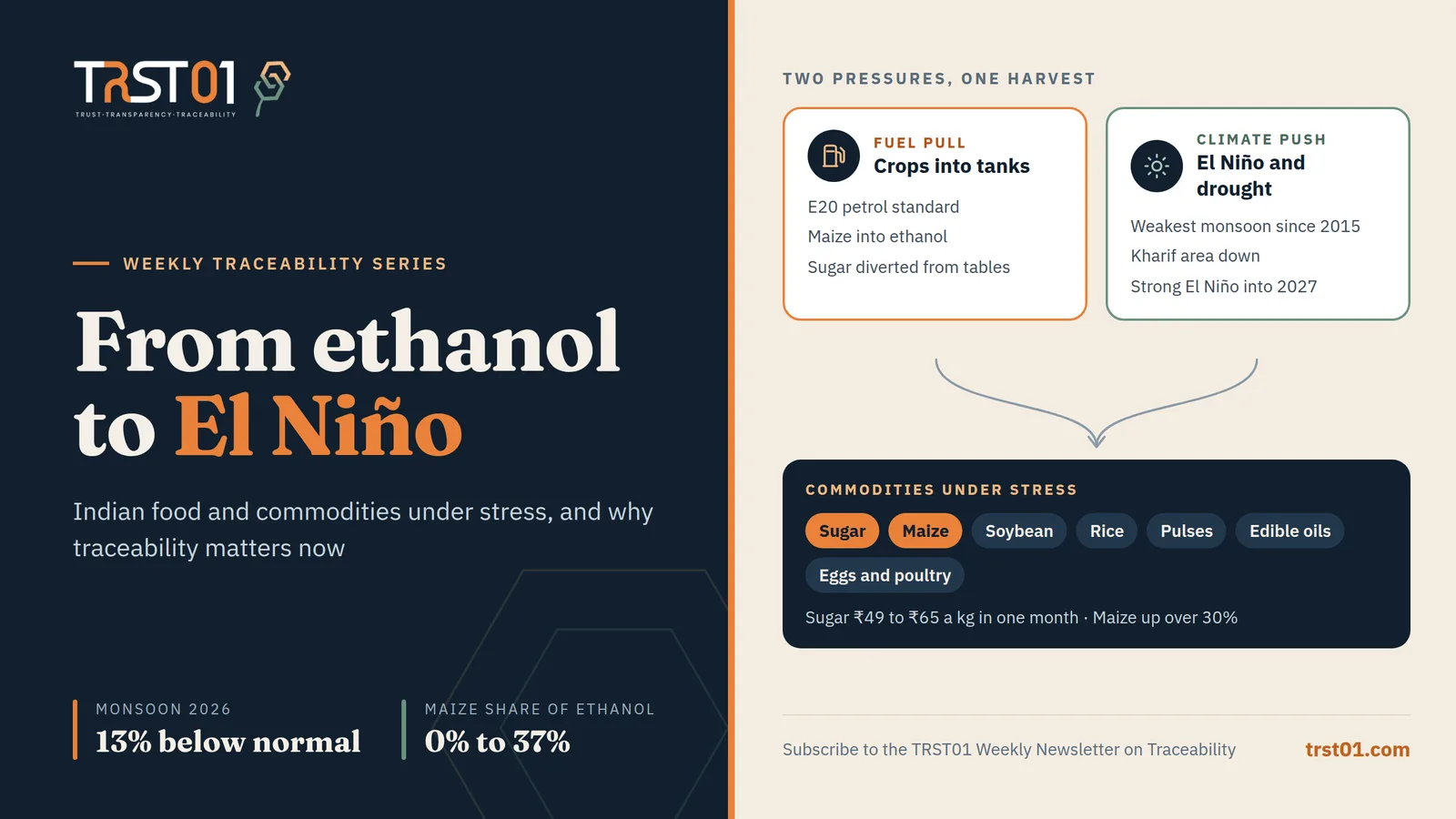
In 2026, India's food and farm commodities are being squeezed from two directions at once. One pull comes from the fuel tank: more crops are going into ethanol. The other push comes from the sky: the weakest monsoon in more than a decade, driven by a strengthening El Niño.
Together, they are tightening supplies of sugar, maize, rice, soybean, pulses and edible oils, lifting prices and changing where India's food comes from. This week we start with soybean, fresh from the International Soy Conclave in Indore, then look at Europe's new deforestation rule, ethanol and the monsoon, and why knowing where every lot comes from has never mattered more.
The soybean story: dear at home, cheaper abroad
Soybean shows both pressures inside a single crop. In Indore, India's main soybean market, soybean averaged about ₹7,000 a quintal (100 kg) in mid October, with top lots fetching up to ₹7,300.[1] At about ₹95 to the US dollar,[2] that is roughly $735 a tonne. Soybeans from Argentina, Brazil and the United States are being offered at about $497 to $523 a tonne.[3] Even allowing for freight and quality, world prices are well over $150 a tonne below Indian prices.
The same gap shows up in soybean meal, India's main soy export. Indian meal is offered at about $613 a tonne against about $428 internationally, and India's oilmeal exports fell 65% in July.[4] High prices are good news for farmers this season, but they leave processors squeezed and exporters priced out.
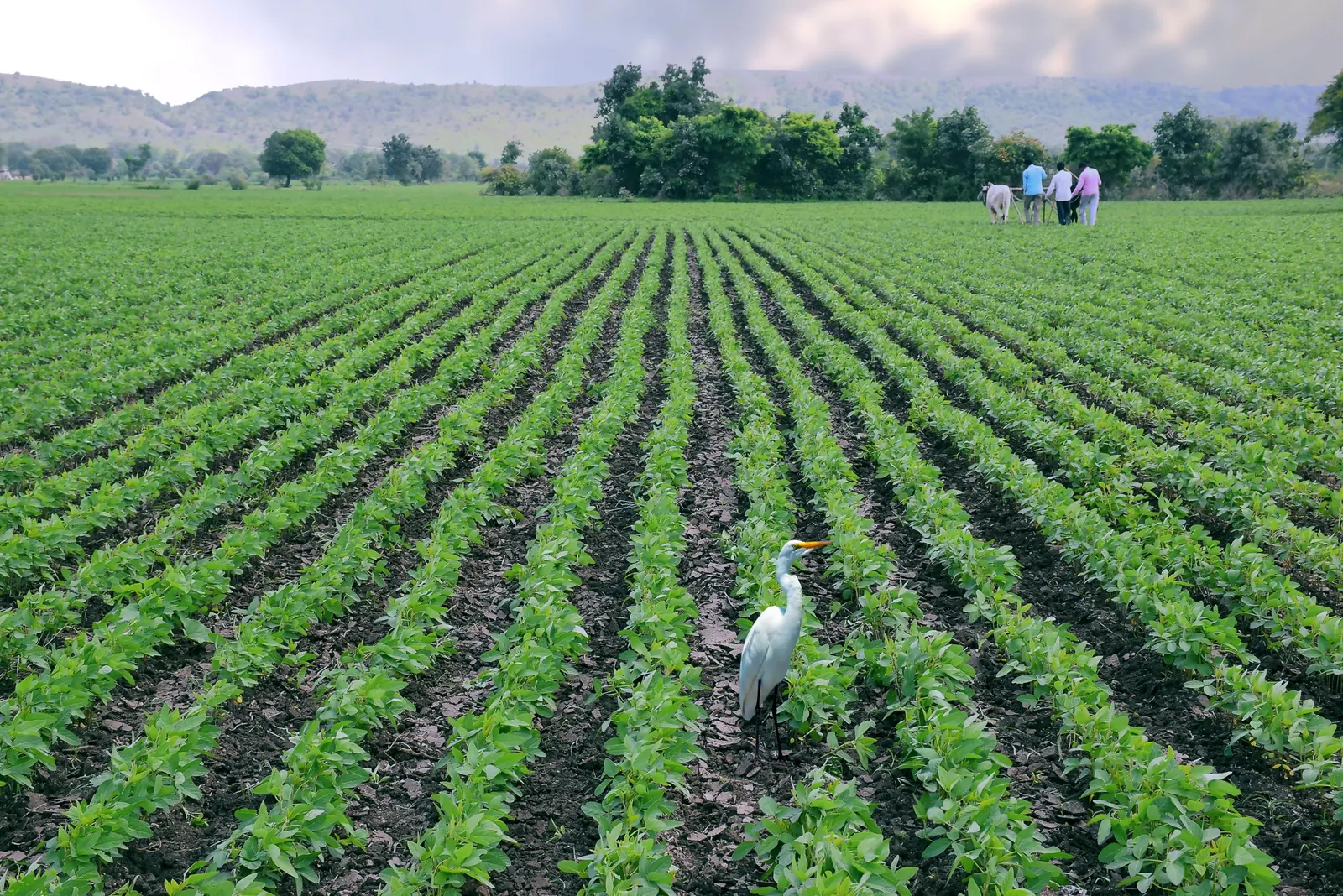
I was at the 9th International Soy Conclave in Indore on 16 and 17 October 2026,[5] the international soybean conference hosted by the Soybean Processors Association of India (SOPA), and the mood in the room was clear. Madhya Pradesh's Chief Minister told delegates that "the impact of El Niño this year was beyond anyone's control," even as early production figures in the state look encouraging.[6] The uncertainty is greater than anyone would like. Processors are unsure about supply, farmers about prices, and exporters about how long India can stay competitive.
Some headlines from the conference. More than 900 delegates met under the theme "Atmanirbhar Bharat: Powering the Oil and Protein Vision". Madhya Pradesh, which grows about 45% of India's soybean, said its farmers had performed well despite El Niño,[7] and planting held up at about 11.1 million hectares (111 lakh) by late July according to SOPA.[8] SOPA president Naresh Goenka pointed out that India still sources about 57% of its vegetable oil from abroad, and urged stable import duties, more domestic soybean cultivation, support for non-GM soybean meal and incentives for soymeal exports.[9] Processors also called for an integrated soybean production policy and wider promotion of soy as a vegetarian protein.
Processors were also firm that India should not allow genetically modified (GM) soybean imports. D N Pathak, Executive Director of SOPA, put it plainly: "We want to strongly state that the import of GM soybeans into India should not be allowed under any circumstances." He added: "If cheap GM soybeans from top producers like the US, Brazil, and Argentina come to India, who will buy soybeans from domestic farmers?"[9] In the industry's view, India's non-GM status earns buyer trust and, often, a better price, and opening the door to GM soy to ease a short-term squeeze would put that advantage at risk for years.
Europe is where that advantage counts most. Germany and the Netherlands have long bought Indian soymeal because it is non-GM, but high prices have already cut India's 2025/26 soymeal exports to an expected 900,000 tonnes, less than half the year before.[10] Winning those buyers back will take more than price. It will take a lot that is non-GM and can prove where it was grown, which is exactly what Europe's new rule asks for. Keeping Indian soy non-GM, and proving it, depends on knowing where every lot was grown and keeping it separate from anything that is not. Under stress, a clean, provable origin is not a cost. It is what keeps Indian soy in the market.
EUDR and the EU export squeeze
The EU Deforestation Regulation (EUDR) applies from 30 December 2026 for large and medium companies and from 30 June 2027 for micro and small ones. It covers soy, coffee, rubber, cattle (including leather), cocoa, oil palm and wood. Every shipment needs the latitude and longitude of each farm plot (a full boundary for plots over four hectares), proof that the land was not deforested after 31 December 2020, and records that the crop was produced legally.[11] The European Commission's May 2026 review trimmed paperwork but kept these dates in place.[12]
India's low risk rating helps. EU authorities plan to check about 1% of operators sourcing from low risk countries, against 3% for standard risk and 9% for high risk, and buyers can skip the full risk assessment. But plot coordinates and legality records are still required, and buyers must check that the product was not mixed with produce from higher risk origins.[13]
This is where El Niño and the EUDR meet. As India imports more soybean, edible oil and pulses, more foreign produce flows through the same traders, warehouses and crushing plants that serve exporters. A plant that crushes imported beans alongside Indian beans has to prove which beans went into an EU cargo. India's low risk status covers Indian origin. It does not cover a lot that cannot show where it came from.
The money at stake is real. A 2023 estimate by the Global Trade Research Initiative, based on 2022 trade, put about $1.3 billion of Indian exports to the EU under the rule, led by coffee, wooden furniture, paper, oilcake and leather.[14] Coffee has grown sharply since: India's coffee exports to all markets reached about $1.97 billion in 2025, with Italy, Germany and Belgium among the largest buyers.[15] Now the weather is cutting into that crop. USDA expects India's 2026/27 coffee output to fall about 4%, with June rainfall about 35% below normal in Kodagu,[16] and on 13 October the Karnataka Planters' Association warned that drought could cut the state's coffee output by 15 to 20%.[17]
Smaller crops, higher prices and a stricter EU rule are arriving in the same season. When buyers have cheaper options elsewhere, a lot without plot data is easy to drop. A lot verified from farm to port gives them a reason to stay. Exporters who have plot data in hand when the EU importer files its due diligence statement will keep their place in the queue. Those who start collecting it in December will find the buyer has already moved on. Under stress, proof of origin is one of the few advantages India can still offer Europe.
The fuel pull: crops into tanks
India met its 20% ethanol blending target in 2025, five years ahead of schedule,[18] and E20 petrol, with 20% ethanol, became the standard across India from 1 April 2026.[19] That ethanol increasingly comes from food crops.
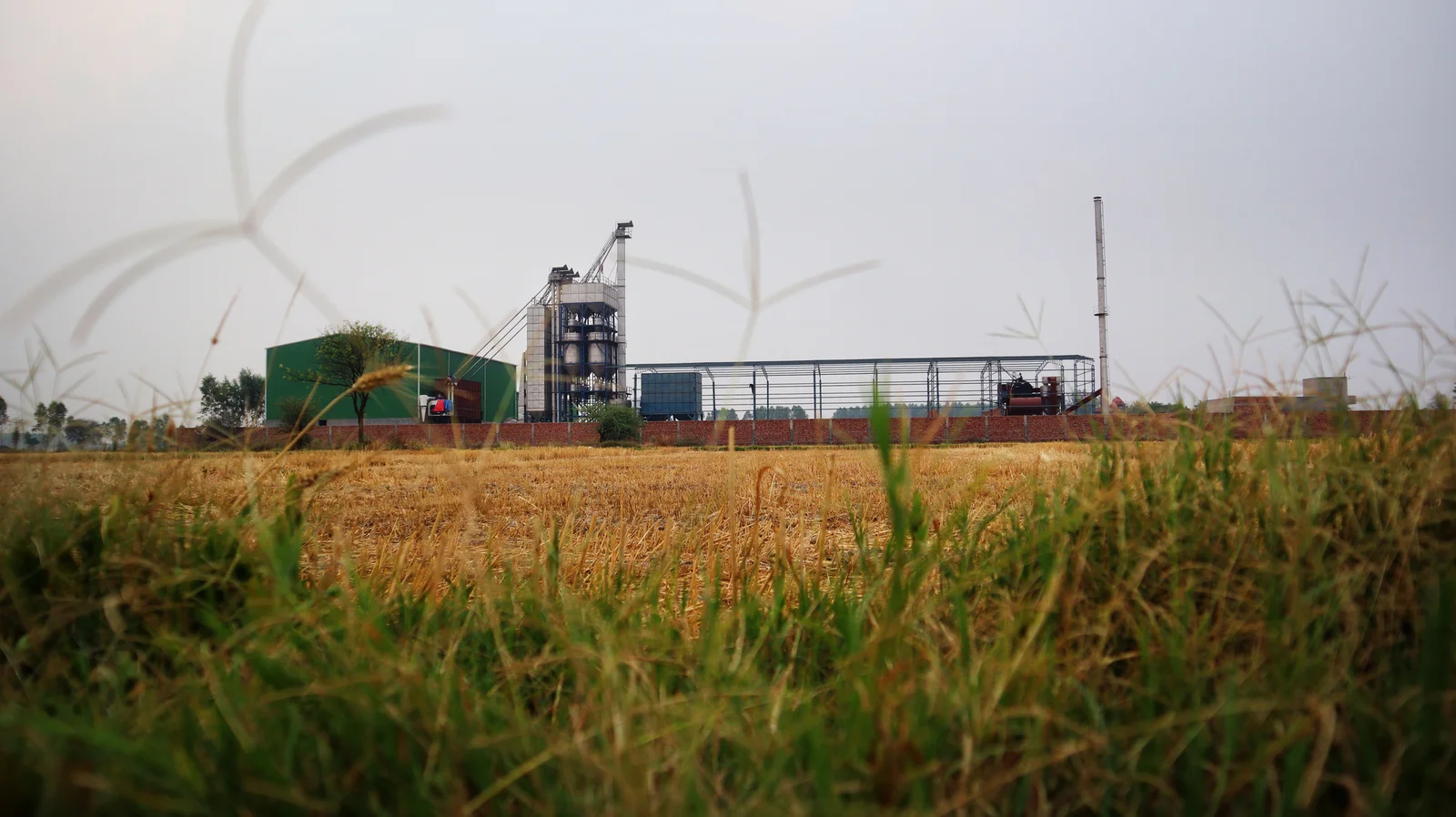
Maize. Maize's share of India's ethanol has risen from 0% in 2021/22 to about 37% in 2025/26, using roughly 12.6 million tonnes of maize, and nearly three quarters of India's ethanol now comes from grains. Even with a record crop of about 55 million tonnes, India has turned from a net exporter of maize to a net importer.[20] Maize makes up around 55% of poultry feed by weight. Feed rose from about ₹25 a kg in April to more than ₹30, wholesale maize is over 30% above its May and June level, and wholesale egg prices in Delhi were about 39% higher in July than a year earlier.[19]
Sugar. About 3 million tonnes (30 lakh) of sugar went into ethanol in 2025/26, and stocks carried into the new season fell to about 3.75 million tonnes from 5 million a year earlier.[21] Business Today reported sugar prices jumping from around ₹49 a kg at the end of July to ₹65 at the end of August.[19] India exported only about 800,000 tonnes (8 lakh) this season, against an average of 6.8 million tonnes a year in the five seasons to 2022/23, when it supplied about a tenth of world trade.[22] The government now plans to restrict the use of cane juice, syrup and B-heavy molasses for ethanol from the 2026/27 season starting in November, while keeping the E20 programme unchanged.[21]
Rice: the next feedstock. Between June 2025 and June 2026, the Food Corporation of India sold 6.35 million tonnes of rice to distilleries at ₹2,250 to ₹2,320 a quintal, about 40% below its own cost of roughly ₹3,720 to ₹3,890.[23] For the ethanol year starting 1 November, the allocation has been raised to 7.2 million tonnes (72 lakh) from 5.2 million tonnes,[24] with the final quantity to be decided by a ministerial committee.[25] The government says this is surplus rice and that public distribution is protected. But it is being expanded just as El Niño hits this year's paddy crop, and every tonne that moves from a granary to a distillery has to be accounted for.
The climate push: El Niño and a failing monsoon
India received 759.4 mm of rain between June and September 2026, against a long period average of 868.6 mm, a shortfall of about 13%.[26] It was the weakest monsoon since 2015.[27] East and Northeast India received only 74% of normal rain and South Peninsular India 76%. About 19% of the assessed area was in moderate to extreme drought by mid September, rising to 74% in Andhra Pradesh.[26] In most crops, the area planted this kharif season is lower than last year.[28]
The US Department of Agriculture cut its estimate of India's 2026/27 rice crop from 154 to 147 million tonnes,[27] and India's maize crop is expected to fall by about 10%.[19] US forecasters see a greater than 90% chance of a strong El Niño lasting through January to March 2027, with below normal winter rain in many regions,[26] which puts the next rabi crop at risk too.
More imports, new origins
When home supply tightens, India buys more from abroad. Projected imports now include about 7.5 million tonnes of pulses, 16 to 17 million tonnes of vegetable oils and more than 7 million bales of cotton, even as rice buffer stocks stand at about 40 million tonnes.[28] Maize imports face a 15% duty for the first 500,000 tonnes and 50% beyond that.[20] Every new import brings new origins, new suppliers and new risks, from residue standards to whether a product really came from where its papers say.
Why stress makes traceability more important, not less
When commodities are plentiful, gaps in records are easy to ignore. When they are scarce and expensive, those gaps become costly. Five reasons stand out:
1. Policy needs real numbers. Limits on ethanol diversion, export curbs and stock limits all depend on knowing who holds what, and where.
2. Price spikes invite shortcuts. When sugar, edible oil or spices get expensive, the temptation to mix or mislabel grows. Lot records from farm to pack are the best defence.
3. Imports must be proven too. New origins need the same scrutiny as domestic supply, and must be kept apart from export lots.
4. Export buyers want continuity. Foreign buyers worry when India restricts exports. Exporters who can show exactly where their supply comes from, and how much they can commit, keep their customers through a difficult season.
5. Farm data protects farmers. Plot level records make crop insurance, drought relief and credit faster and fairer when farmers need them most.
Not just an Indian story
El Niño does not stop at India's borders. The World Meteorological Organization expects hotter, drier conditions across Indonesia, Australia and parts of South Asia, and analysts rank Southeast Asia alongside India, Brazil and Australia among the regions with the largest downside risk to farm output.[29]
Palm oil shows how quickly that can travel. Malaysia and Indonesia produce 88% of the world's palm oil, and stocks are thin at just under 12% of annual use, so a shortfall of only a few percentage points in Indonesia could move global prices.[30] Palm oil is also an EUDR commodity, as are the coffee, cocoa and rubber grown across Southeast Asia and Africa. In past El Niño years, parts of southern Africa have faced drought as well.
So exporters of palm oil in Indonesia, rubber in Thailand and Vietnam, and coffee and cocoa across East and West Africa face the same mix this season: tighter supply, higher prices and European buyers asking harder questions. The tools that help an Indian soymeal plant or coffee estate through this season will help them too.
Six things to do this season
1. Map your supply. Know which farms, collectors and stockists your raw material comes from.
2. Track every lot. Give each lot an ID that follows it through storage, processing and dispatch, including any part that goes to ethanol or export.
3. Check new suppliers and imports. Ask for origin and quality records before you buy.
4. Watch stock, export and diversion limits. Keep records ready for changing government rules on stocks, exports and ethanol use.
5. Get EU shipments EUDR ready. For soymeal, coffee, rubber, palm oil or leather headed to Europe, collect plot coordinates and legality records now. You can check your plot data free with the EUDR Polygon Validator.
6. Capture farm level climate data. Record sowing, rainfall and crop condition by plot, so insurance, finance and buyer conversations rest on evidence.
The bigger picture
Food, fuel and climate are now one system. A fuel policy changes what farmers plant, a warm patch of Pacific Ocean changes what they harvest, and a rule in Brussels changes who will buy it. In a system this connected, traceability is how a country, and every business in it, knows what it really has.
For exporters, the lesson of this season is simple. Prices will cool, rains will return and El Niño will fade. The records you build now, farm by farm and lot by lot, will still be there when they do, and they are what European buyers, lenders and regulators will ask to see first. The businesses that treat this year as a reason to get their data in order will come out of it stronger than they went in.
At TRST01, we build traceability infrastructure that links farms, stocks, processing and shipments into one verifiable record, for exporters, processors and governments. Learn more at trst01.com.
Subscribe to the TRST01 Weekly Newsletter on Traceability for a plain language update every week on the rules and risks shaping global trade. Share this with someone in the food or commodity business who needs to see it.
References
[1] CommodityOnline, "Soyabean price today in Indore" (data for 15 October 2026). commodityonline.com
[2] Trading Economics, Indian rupee exchange rate (16 October 2026). tradingeconomics.com
[3] IndexBox, "EU Oilseeds Observatory weekly world export prices: soyabeans and rapeseed FOB" (15 October 2026). indexbox.io
[4] UkrAgroConsult, "India cuts oilmeal exports by 65% amid competition from Argentina and Brazil" (14 October 2026). ukragroconsult.com
[5] Global Agriculture, "International Soy Conclave 2026 rescheduled to October 16–17 in Indore". global-agriculture.com
[6] ThePrint, "Despite El Niño, initial figures on soybean production in MP are encouraging: CM Mohan Yadav" (17 October 2026). theprint.in
[7] Women Express, "Madhya Pradesh moving fast in food processing and soya industry: CM Dr Mohan Yadav" (17 October 2026). womenexpress.in
[8] iGrain, "SOPA's soybean sowing area figures exceed government estimates" (23 July 2026). igrain.in
[9] Daily Excelsior (PTI), "Import of GM soybeans into India should not be allowed at all, say processors" (17 October 2026). dailyexcelsior.com
[10] UkrAgroConsult, "India's soymeal exports could fall to four year low amid sharp price surge" (21 May 2026). ukragroconsult.com
[11] European Commission, "Regulation on deforestation-free products". environment.ec.europa.eu
[12] Arendt, "EUDR simplification review published: what the 2026 package means for in scope companies" (18 May 2026). arendt.com
[13] ATIBT, "EUDR: Commission publishes first country benchmarking list" (24 May 2025). atibt.org
[14] Devdiscourse (PTI), "India's exports to EU worth USD 1.3 bn to be impacted by EU's deforestation regulation: GTRI report" (18 May 2023). devdiscourse.com
[15] India Seatrade News, "Indian coffee exports cross $2 billion mark on strong Russian buying" (2 January 2026). indiaseatradenews.com
[16] StoneX, "India's coffee crop faces mounting weather stress as weak monsoon follows early season deluge" (8 September 2026). stonex.com
[17] Kodagu Express, "El Niño threat looms over Karnataka coffee crop, production may fall 15 to 20%: KPA" (13 October 2026). kodaguexpress.com
[18] The Wire, "Union govt: E20 target achieved five years in advance" (24 July 2026). thewire.in
[19] Business Today, "Sugar to maize: why ethanol demand could make your eggs and chicken costlier" (16 September 2026). businesstoday.in
[20] Scroll, "Eggs, chicken could cost more as maize shortage due to ethanol blending will worsen amid poor rain" (30 September 2026). scroll.in
[21] Onmanorama, "India restricts ethanol production from sugarcane as sugar output declines" (6 October 2026). onmanorama.com
[22] Business Recorder, "India likely won't export sugar for years as El Niño, ethanol squeeze supply" (22 June 2026). brecorder.com
[23] Deccan Herald, "FCI supplied rice to ethanol distilleries at 40% below acquisition cost: Centre tells Rajya Sabha" (29 July 2026). deccanherald.com
[24] ChiniMandi, "Centre raises FCI rice allocation for ethanol production to 72 lakh tonnes" (20 July 2026). chinimandi.com
[25] IndianAgri, "OMSS 2026/27: rice at ₹2,320 for ethanol, wheat at ₹2,585" (3 July 2026). indianagri.com
[26] ETV Bharat, "El Niño, India's deficient 2026 monsoon and the risks ahead" (16 October 2026). etvbharat.com
[27] Tech Times, "India monsoon 2026 ends with worst deficit in over a decade, IMD confirms" (30 September 2026). techtimes.com
[28] Free Press Journal, "El Niño hits the production of the 2026/27 kharif crop" (15 October 2026). freepressjournal.in
[29] S&P Global, "Factbox: El Niño may disrupt global food supplies as farm output falls" (3 August 2026). spglobal.com
[30] Marex, "El Niño impact on Malaysian and Indonesian palm oil production" (10 June 2026). marex.com