What CBP’s Supply Chain Visibility Proposal Means for Exporters
Last week we counted down 100 days to the EU Deforestation Regulation.[5] This week the pressure comes from the other side of the Atlantic.
On 2 September 2026, US Customs and Border Protection (CBP) published an advance notice of proposed rulemaking called “Heightened Import Disclosures for Supply Chain Visibility.”[1] It is not a final rule yet. It is CBP asking the trade community, in public, how it should see deeper into the supply chains behind goods entering the United States.[3]
If you export to the US, whether phones, pharmaceuticals, gems, textiles or shrimp from India, garments from Bangladesh, seafood from Vietnam, coffee from Uganda, spices from Sri Lanka, or rubber products from Malaysia, this is worth your attention now, while the rules are still being shaped.
What CBP is considering, in plain words
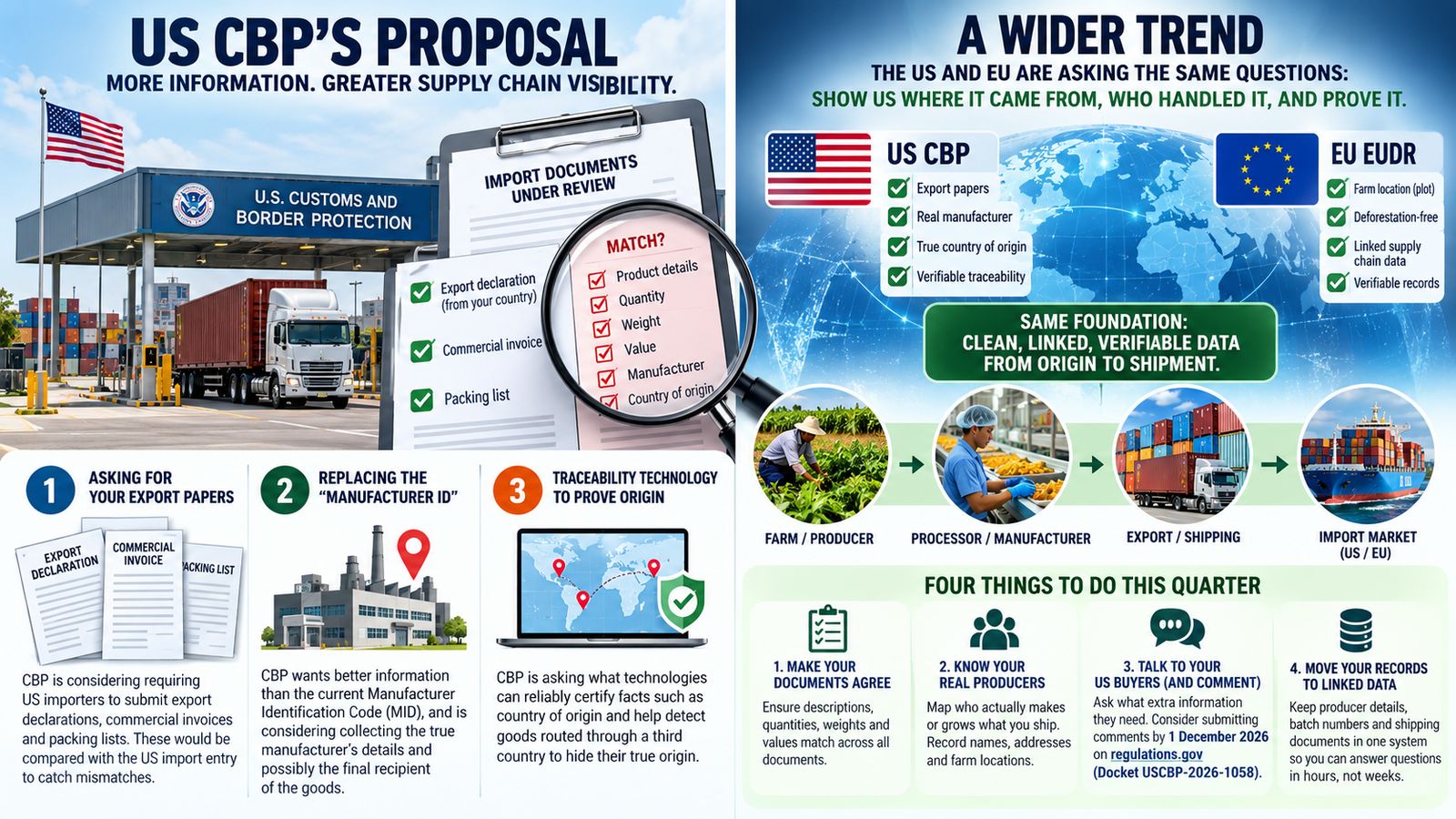
The proposal supports a US executive order signed in June 2026[4] that aims to tighten import rules and raise penalties for failing to comply. In its news release[2], CBP says it wants to spot risky shipments earlier and stop goods that evade customs laws. Three ideas stand out.
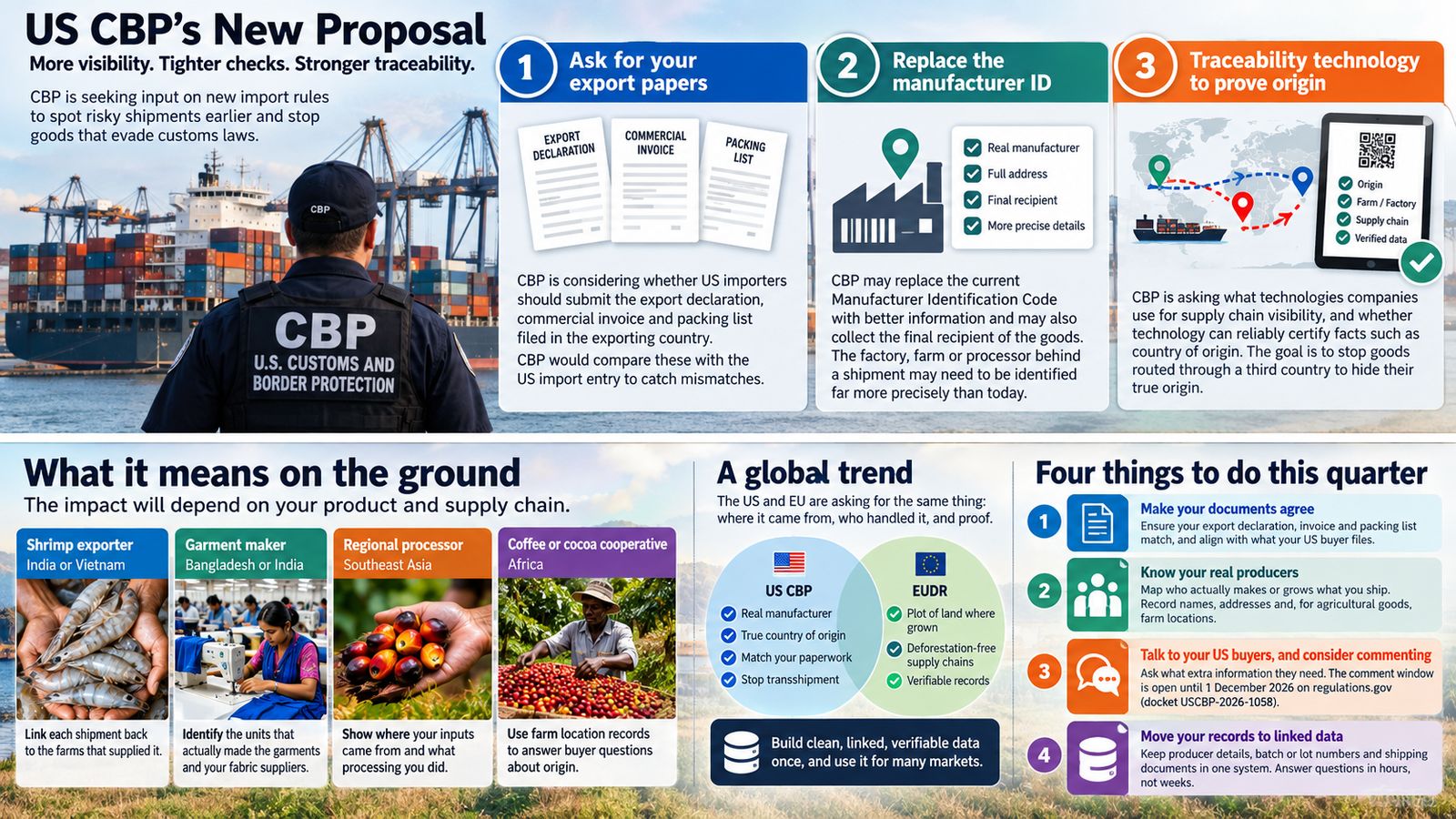
1. Asking for your export papers. CBP is considering whether US importers should submit the documents filed in the exporting country: the export declaration made to your own customs authority, the commercial invoice, and the packing list.[1] CBP would compare these with the US import entry to catch mismatches. What you declare at home and what your buyer declares in the US may soon be checked against each other.
2. Replacing the “manufacturer ID.” Today, US entries use a Manufacturer Identification Code (MID) built from a manufacturer’s or shipper’s name and address. CBP admits this code often fails to identify the party that actually made the goods, and it arrives too late in the process.[3] It is asking whether to collect better information instead, and whether to name the final recipient of the goods too. The factory, farm or processor behind a shipment may need to be identified far more precisely than today.
3. Traceability technology to prove origin. CBP is especially concerned about goods routed through a third country to hide where they really came from. It is asking what technologies companies already use for supply chain visibility, and whether technology can reliably certify facts such as country of origin.[3] In effect, CBP is asking the industry to show what credible, verifiable traceability looks like.
Where the process stands
An advance notice is the earliest stage of US rulemaking. CBP has not decided anything yet. After the comment period closes, it will review what it hears and may publish a formal proposed rule, which would open another round of comments before any final rule takes effect. That gives exporters and their buyers time, but not a reason to wait. The questions CBP is asking show clearly where it wants to go, and US importers are likely to start asking their suppliers for more detail well before any rule is final.
What it could look like on the ground
The same proposal will feel different depending on what you ship and how your supply chain is built. A few examples:
A shrimp exporter in India or Vietnam. The processing plant is usually the name on the paperwork, but the product starts at hatcheries and farm ponds, often owned by many small farmers. If CBP asks who really produced the goods, the plant will need records that link each shipment back to the farms that supplied it.
A garment maker in Bangladesh or India. Orders are often split between a main factory and smaller subcontracted units, with yarn and fabric bought from several mills. Today the manufacturer code may point to the exporter rather than the unit that actually sewed the garments. A tighter identity requirement would expose these gaps.
A processor in Southeast Asia that buys raw material from neighbouring countries. This is exactly the situation CBP worries about when it talks about goods routed through a third country. A processor in this position will need to show where its inputs came from and what it did to them, so that the country of origin on the invoice can be defended.
A coffee or cocoa cooperative in Africa. Lots are built up from hundreds or thousands of smallholders. Many cooperatives are already collecting farm locations for EUDR. The same records, linked to each export lot, can answer a US buyer’s questions about origin with very little extra work.
Why this matters beyond the US
Put this next to EUDR[5] and a clear pattern appears. Both of the world’s largest consumer markets are moving towards the same demand: show us where it came from, who handled it, and prove it with records that match.
The EU wants to know the plot of land where a commodity was grown. The US wants to know the real manufacturer and the true country of origin, and to check your paperwork against your buyer’s. The questions differ in detail, but they rest on the same foundation: clean, linked, verifiable data from origin to shipment.
Exporters who build that foundation once can reuse it for many markets. Those who treat each regulation as a separate paperwork exercise will pay for the same work again and again.
Four things to do this quarter
1. Make your documents agree with each other. Check that the product descriptions, quantities, weights and values on your export declaration, invoice and packing list match, and that they match what your US buyer files. Small inconsistencies that nobody checked before may now raise flags.
2. Know your real producers. Map who actually makes or grows what you ship, not just the trading company or consolidator on the invoice. Record names, addresses and, for agricultural goods, farm locations. This one exercise serves both EUDR and the US push on manufacturer identity.
3. Talk to your US buyers, and consider commenting. Ask your importers what extra information they expect to need. The comment window is open until 1 December 2026 on regulations.gov under docket number USCBP-2026-1058.[6] Exporters’ associations and industry bodies in India, South Asia, Southeast Asia and Africa should consider submitting comments, so that the final rule reflects how smallholder supply chains with many tiers really work.
4. Move your records from paper to linked data. Scanned PDFs in email folders are hard to search and harder to match. Keep producer details, batch or lot numbers, and shipping documents in one system where each export lot is linked to its source. When a buyer or an authority asks a question, you can then answer in hours rather than weeks.
The bigger picture
Traceability is quickly becoming a condition of market access, not a marketing extra. The good news is that the data one market asks for is largely the data every market will ask for. Getting it right once, at origin, is the most economical compliance strategy an exporter can have.
There is also an opportunity here. Buyers under pressure from regulators will prefer suppliers who can answer questions quickly and completely. For exporters in India, South Asia, Southeast Asia and Africa, strong traceability can become a reason to be chosen, not just a cost of doing business.
At TRST01, we build traceability infrastructure that links farm, factory and shipment data into a single verifiable record, ready for EU, US and other market requirements. Learn more at trst01.com.
Subscribe to the TRST01 Weekly Newsletter on Traceability for a plain language update every week on the rules shaping global trade. Share this with an exporter who needs to see it.
References
[1] US Federal Register, “Heightened Import Disclosures for Supply Chain Visibility,” advance notice of proposed rulemaking (2 September 2026). https://www.federalregister.gov/documents/2026/09/02/2026-17926/heightened-import-disclosures-for-supply-chain-visibility
[2] US Customs and Border Protection, news release announcing the advance notice of proposed rulemaking. https://www.cbp.gov/newsroom/national-media-release/cbp-announces-advance-notice-proposed-rulemaking-enhance-supply
[3] Supply Chain Dive, “CBP wants stakeholder input on supply chain visibility push” (8 September 2026). https://www.supplychaindive.com/news/cbp-wants-stakeholder-input-on-supply-chain-visibility-push/829687/
[4] Supply Chain Dive, “Trump is shaking up customs rules. What should shippers know?” (16 June 2026). https://www.supplychaindive.com/news/trump-is-shaking-up-customs-rules-what-should-shippers-know/822731/
[5] European Commission, Regulation on deforestation free products (EUDR). https://environment.ec.europa.eu/topics/forests/deforestation/regulation-deforestation-free-products_en
[6] Federal eRulemaking Portal, regulations.gov (docket USCBP-2026-1058). https://www.regulations.gov/